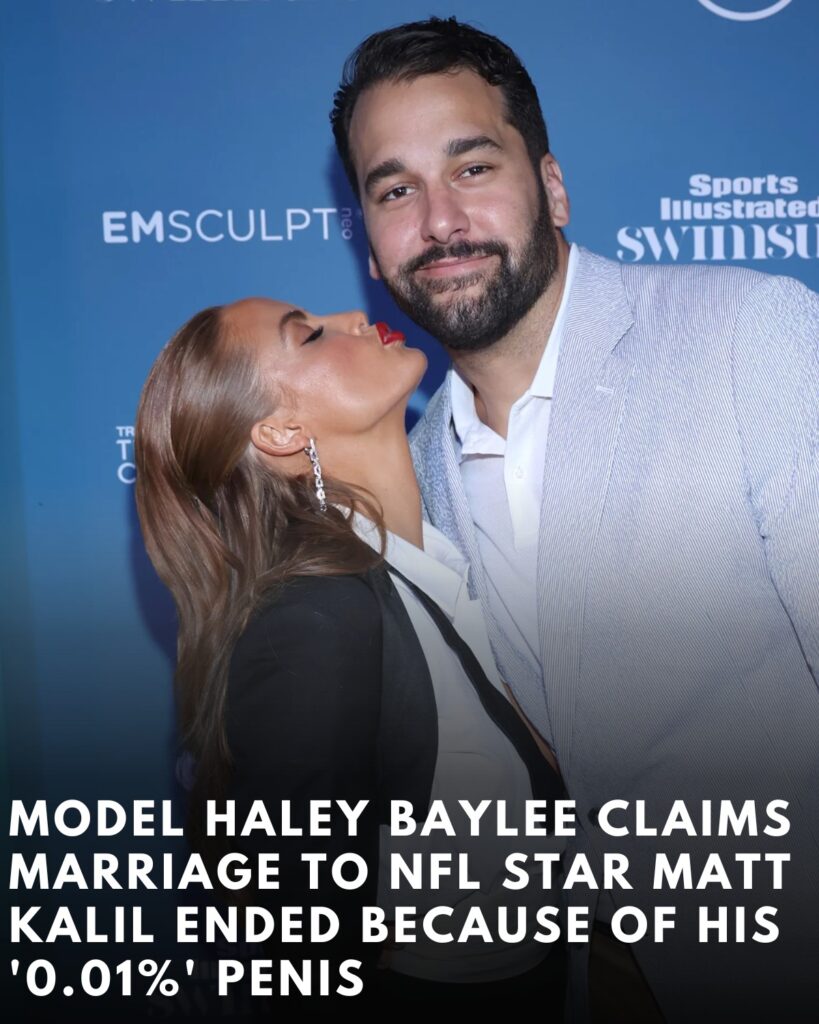
Influencer and model Haley Kalil, known to many of her followers as Haley Baylee, has said the principal reason her marriage to former NFL lineman Matt Kalil ended in 2022 was an intimate, medical-type challenge she described as extremely rare and physically unworkable. Speaking during a live-streamed conversation with Twitch creator Marlon Garcia, Kalil said the couple’s sex life became the decisive issue despite attempts to resolve it with professional help, and she characterised the underlying factor as a one-in-ten-thousand anatomical outlier. In the broadcast, she referred to her ex-husband’s size as being in the “0.01 percent” of the population and, when pressed by the host on whether the problem persisted throughout their relationship, she replied it existed “for our whole marriage.” She added that they “tried it all: therapist, doctors,” and even looked into “lipo-type” interventions before concluding that intimacy was not realistically possible without pain. “It’s like my life is a comedy, and it writes itself,” she said on the stream while stressing she still cared about him and did not intend to embarrass him.
Kalil filed for divorce in May 2022 after nearly seven years of marriage, citing irreconcilable differences. Coverage of the Twitch appearance noted that she avoided saying the description aloud initially, instead typing it on her phone for the host to read, before confirming on camera that the issue was the central factor in the breakdown of the marriage. During the same live-stream, she emphasised that the two had a broadly positive relationship in other respects and that she retains affection and respect for her ex-husband. “He’s a great guy and we’re still friends,” she said, framing the disclosure as candid context rather than a grievance.
Kalil’s remarks quickly drew wide attention because of the explicit nature of the claim and the specificity of the “0.01 percent” characterisation, which is how she framed the statistical rarity of the challenge. In follow-up comments reported after the stream, Kalil attempted to re-centre the discussion around the fuller tenor of the conversation, saying that the hour-plus chat covered “the love in our marriage, the growth we experienced, the depth of our connection,” and that she cared “deeply about respecting his privacy and the integrity of what we shared together.” Her clarifying tone underscored an effort to separate a headline-driven snippet from a broader, more nuanced account of a marriage that ultimately ended because—by her account—intimacy was physically untenable despite attempts to find compromise or clinical solutions.
External reporting on the live-stream reiterated several of the details she placed on the record. Descriptions of the conversation cite her graphic shorthand—she compared the problem, metaphorically, to “two Coke cans on top of each other, maybe even a third”—in illustrating the practical barrier the couple faced. That comparison, while intentionally colourful, was presented in context as part of her explanation for why counselling and medical consultations did not produce a sustainable path forward. She indicated the pair considered options that would ordinarily be far outside what most couples contemplate, before concluding that their situation was unresolvable in a way that would preserve both partners’ dignity and wellbeing.
People familiar with the couple’s history will recognise the timeline. Haley O’Brien, who models and publishes content under the names Haley Kalil and Haley Baylee, married Matt Kalil in 2015 after the pair met several years earlier, and the two renewed their vows the following year. She petitioned for divorce in 2022. In the period since the split, both have moved on personally: reports note that Matt Kalil remarried model Keilani Asmus in 2024 and the couple welcomed a child later that year, while Haley Kalil has continued her content career, regularly posting to audiences that number in the many millions across TikTok and Instagram. These biographical details formed part of the factual frame that surrounded the viral attention on her new comments.
Reaction to the disclosure has included both sympathy and criticism from viewers. Some social-media responses described the decision to share explicit marital details as oversharing or a breach of trust, while others framed the discussion as two adults navigating a rare, sensitive health-adjacent obstacle that ultimately could not be solved. The live-stream, which was conversational in tone and ranged far beyond the one quote that drew headlines, also touched on the pair’s attempts to protect each other throughout the divorce process. Kalil said they kept the legal proceedings amicable, and several outlets reported her comment that they even coordinated their approach with a shared lawyer, a point offered to illustrate that there was no adversarial litigation seeking to assign blame beyond the practical barrier she described.
Matt Kalil, 35, has not publicly responded to the specific claims made on the stream at the time of publication. A former left tackle who entered the NFL as the fourth overall pick in the 2012 draft, he earned Pro Bowl honours as a rookie with the Minnesota Vikings before later stints with the Carolina Panthers and Houston Texans. After injuries curtailed his career, he entered business ventures including a tequila brand launched with his brother, fellow NFL lineman Ryan Kalil. His recent personal life, as noted, includes his marriage to Asmus in Las Vegas in 2024 and the birth of a son later that year. These details have been highlighted in reports as part of a broader picture of both former spouses moving into new chapters privately and professionally.
For Haley Kalil, the episode comes amid continued growth as a digital-first public figure. She has built an audience counted in the tens of millions across platforms, parlaying a Sports Illustrated Swimsuit launchpad into a full-time creator career. Her posts often blend light-hearted humour with high-production fashion content, and she has, at times, addressed personal topics directly with followers, from health issues to rumours about her private life. In May this year she parried a death hoax with a deliberately tongue-in-cheek “obituary” on Instagram—an example of the self-aware, meme-literate style that has helped her cultivate a large, highly engaged audience. That history helps explain why a candid, highly personal disclosure on a long, casual live-stream could spread quickly beyond the audience that watched it live into mainstream outlets within hours.
Kalil’s comments on the stream also sat alongside a conscious effort to humanise her ex-husband, even as she placed the ultimate responsibility for the couple’s split on an issue that she repeatedly emphasised was nobody’s fault. Reports quote her calling him a “great guy,” and she suggested they continue to be on friendly terms. The framing—“biggest factor” rather than sole factor—left open the possibility that there were everyday pressures familiar to most marriages, but she insisted the practical constraints around intimacy were decisive. In that framing, her disclosure was less a charge than a rueful recognition that two people who otherwise loved one another could not find a way to share a normal private life without pain, even with medical and therapeutic support.
The specificity of the “0.01 percent” remark has also prompted discussion about whether such disclosures help normalise conversations around compatibility and sexual health or whether they cross a line of privacy for a former partner who has not chosen to speak. Viewer reactions captured both impulses. Some suggested the story could operate as a cautionary reminder that couples sometimes face rare physiological issues that are not easily solved and that seeking medical advice is appropriate. Others took the view that a public label attached to a named ex-spouse invites ridicule or speculation against someone who did not consent to the publicity, particularly in a case where the subject is identifiable and has his own public profile. Kalil’s subsequent statement asking audiences to consider the full context of the discussion—love, growth, connection—appeared designed to dampen the more salacious readings and to reiterate that her intent was not humiliation.
What remains clear from the on-air exchange is that Kalil believes the couple exhausted reasonable avenues before agreeing to end the marriage. The detail about looking into surgical workarounds—presented with the same wry tone she often uses in her content—underscored the extent to which they sought to keep the relationship intact. By her description, the attempts failed because any physical relationship remained painful or impractical, and she concluded that the humane choice was to separate while retaining mutual respect. That posture—matter-of-fact but careful to credit her ex-husband’s character—has been consistent across the snippets and follow-up remarks published since the stream.
Neither party has alleged misconduct, abuse or infidelity as a driver of the divorce, and there are no court filings cited in recent reports that contradict Kalil’s characterisation of events. Instead, the record to date reflects a private medical-style incompatibility that became public because one half of the former couple elected to discuss it in a conversational broadcast aimed at fans. As with many stories that begin in creator spaces, the content’s reach expanded once traditional celebrity news outlets summarised the segment and audiences began to circulate clipped quotes on social platforms. Kalil’s request that people consider the fuller conversation may temper that dynamic; whether it invites a response from her ex-husband remains to be seen. For now, the public record rests on her words: that the scale of the problem was extraordinarily rare, that they sought professional advice, and that the marriage ended when those efforts could not produce a way forward.