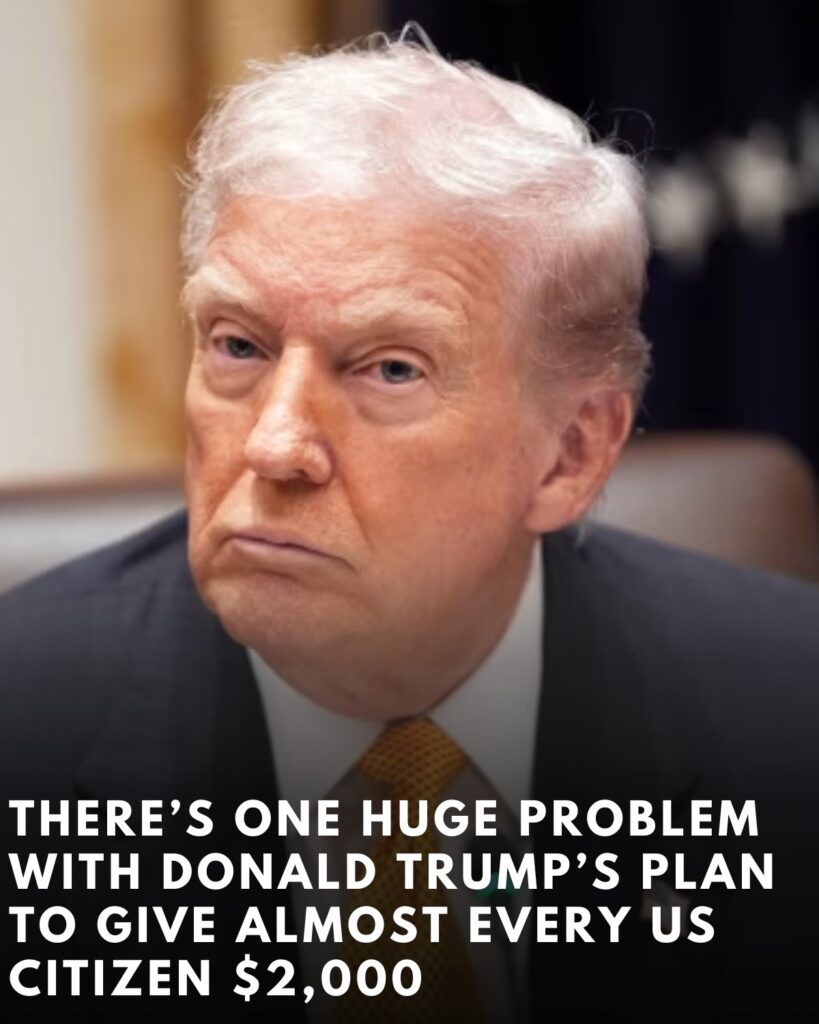
Donald Trump has promised to give almost every American a one-time payment of at least two thousand dollars, funded through tariffs collected on imported goods. The proposal, announced in a post on his social media platform Truth Social, immediately drew both attention and scrutiny over its feasibility, legality and potential impact on the United States economy.
In the post, Trump claimed the country’s economic position was strong enough to fund the payments directly from tariff revenue, writing that “a dividend of at least $2,000 a person (not including high-income people!) will be paid to everyone.” He went on to defend his aggressive tariff policy, calling critics of tariffs “fools” and describing the U.S. as “the richest, most respected country in the world, with almost no inflation.”
The message was one of several economic promises made in recent weeks as the administration continues to highlight tariff policy as a cornerstone of its approach. Trump has repeatedly argued that tariffs imposed on imported goods generate billions in revenue for the government, which could now be redistributed to ordinary Americans as a form of national dividend.
Officials within the administration have echoed his remarks, though they offered little clarity on how the plan would work. Treasury Secretary Scott Bessent told reporters that the payments could take “lots of forms, in lots of ways,” suggesting they might come as direct cheques or as tax exemptions such as “no tax on tips, no tax on overtime, no tax on Social Security, or new deductibility for auto loans.” The lack of concrete details has left open questions about how the program would be funded, administered, or targeted.
The financial mathematics behind the promise pose significant challenges. U.S. customs data shows roughly 195 billion dollars in tariff revenue has been collected through the end of September 2025. Distributing two thousand dollars to every American adult, excluding high-income earners, would likely cost at least 300 billion dollars — far exceeding the available revenue. If children or additional categories of taxpayers were included, the cost would increase substantially.
Economists have also noted that tariffs themselves act as indirect taxes on consumers, since companies often pass higher import costs onto buyers through increased prices. This means much of the revenue Trump hopes to redistribute originates from household spending rather than foreign governments or corporations. Critics argue that turning those funds into rebates would not change the underlying reality that tariffs can raise prices for goods such as electronics, clothing, and vehicles.
Legal complications further complicate the proposal. Several of the tariffs Trump has relied on to generate revenue are currently being challenged in U.S. courts. Lower courts have ruled that some of the measures may have exceeded presidential authority under the 1977 International Emergency Economic Powers Act. The Supreme Court heard arguments this month, with justices expressing scepticism over whether the White House had the power to maintain sweeping tariffs without fresh congressional approval.
Even if the tariffs withstand legal review, the president cannot unilaterally spend the resulting revenue. Under the U.S. Constitution, Congress retains the power of the purse, meaning any direct payment program would require legislation. Previous stimulus payments during the pandemic were approved through acts of Congress, and there is no indication that lawmakers have been consulted or briefed on the mechanics of the proposed tariff dividend.
Administration officials have downplayed the immediacy of the plan, describing it as an “idea” rather than an enacted policy. Bessent, speaking on Sunday television, said discussions were ongoing but “nothing formal” had been presented to Congress. Still, Trump’s promise has drawn attention for its populist tone, with supporters hailing it as a creative way to return government revenue to citizens and critics warning it amounts to a campaign-style pledge without fiscal backing.
Independent analysts have pointed out that even if the government could fund the payments, a sudden transfer of that size could have economic consequences. The last round of stimulus checks during the pandemic contributed to short-term consumer spending surges but also added pressure to inflation, which reached its highest level in decades soon after. With national debt now exceeding thirty-eight trillion dollars and federal deficits nearing two trillion annually, some economists warn that new one-time payments could worsen the fiscal outlook and complicate efforts to stabilise prices.
Proponents of Trump’s plan argue that tying payments to tariff income makes the proposal self-funding and distinct from pandemic-era stimulus programs. They contend that if tariffs on imported goods continue to rise, the U.S. could sustain dividend-style payments on a recurring basis. However, trade experts note that increasing tariffs often provokes retaliatory measures from other countries, which can reduce export demand and harm domestic industries reliant on global supply chains.
There are also practical questions about how eligibility would be determined and who would be excluded as “high-income people.” No thresholds have been defined, and it is unclear whether the payments would phase out gradually or rely on existing tax data to determine qualification. Without specifics, economists say it is impossible to model the fiscal impact accurately.
The broader political message appears clear: Trump is using the proposal to frame tariffs not merely as a protectionist policy but as a source of direct benefit to Americans. In his post, he described the measure as proof that tariffs “work for the people, not against them.” The plan is consistent with his long-running argument that U.S. tariffs are paid by foreign exporters rather than domestic consumers, despite evidence to the contrary from most independent studies.
Public reaction to the idea has been divided. Supporters have praised the notion of reclaiming money from international trade and redirecting it to citizens, calling it a “patriotic dividend.” Critics have dismissed it as unrealistic and potentially inflationary, describing it as a political gesture designed to appeal to voters frustrated by living costs. Financial analysts have warned that if markets perceive the government as pursuing populist cash transfers without corresponding revenue, it could unsettle investor confidence in U.S. debt and fiscal policy.
At present, there are no signs that legislation to implement the proposal is being drafted. The White House has not released figures on the projected cost, administrative structure, or payment timeline. It remains unclear whether the dividend would be issued as direct payments, tax credits, or reductions in payroll deductions. For now, the statement stands as a policy aspiration rather than an operational plan.
If pursued, the initiative would mark one of the largest direct cash distributions in U.S. history, rivaling the pandemic-era relief packages in scale. It would also redefine the political messaging around tariffs by transforming them into a visible domestic welfare mechanism. The proposal underscores Trump’s confidence in using trade duties as a tool of both economic and political strategy, even as legal and fiscal questions cloud the path forward.
For now, the only certainty is that the promise has reignited debate over the effectiveness of tariffs and the limits of executive power in managing their proceeds. Whether the two-thousand-dollar payments ever materialise will depend not only on legal rulings and budget realities but also on congressional willingness to turn a campaign-style pledge into federal policy.