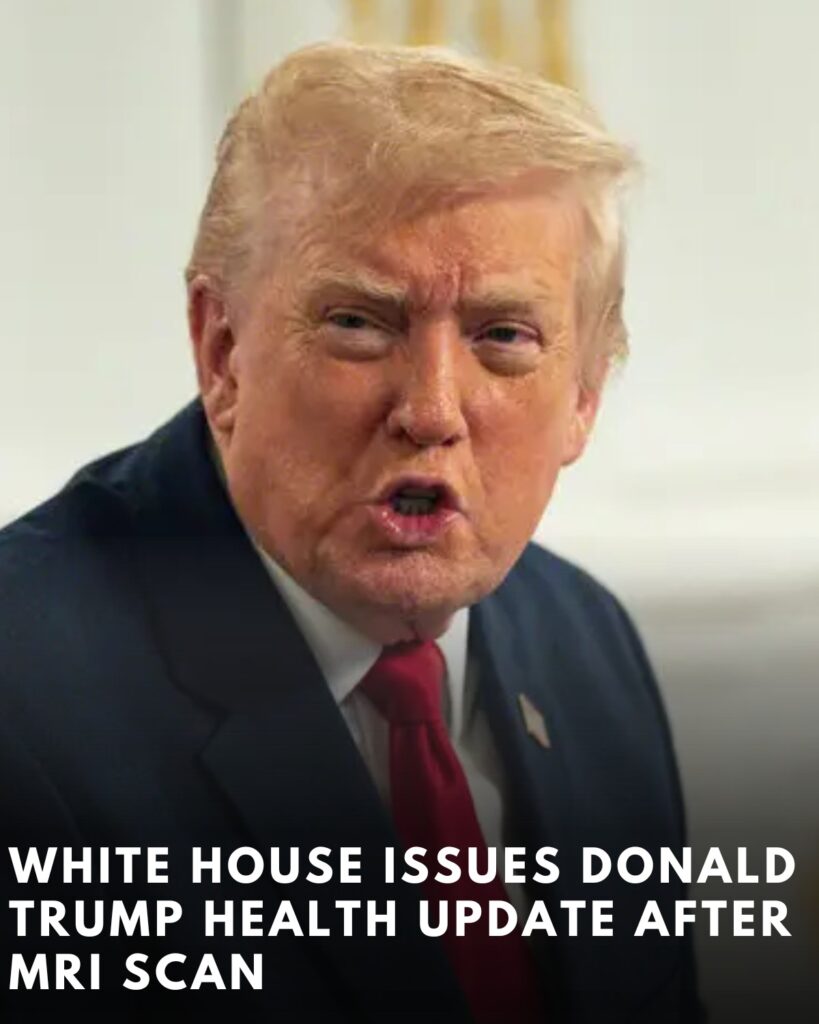
The White House has issued a full update on President Donald Trump’s health, confirming that diagnostic imaging ordered in October revealed no serious medical problems. The MRI and accompanying scans, described by officials as “preventive,” showed no signs of disease in his heart, blood vessels or major abdominal organs. The assessment aims to end weeks of speculation and provide clarity about the 79-year-old president’s fitness for office.
White House Press Secretary Karoline Leavitt addressed reporters, emphasising that the imaging had been recommended solely on the basis of the president’s age as part of routine long-term health monitoring. According to the summarised findings prepared by the White House physician, the heart and major blood vessels appeared normal, with smooth and healthy vessel walls, no narrowing that might impede blood flow, and no evidence of inflammation or clotting. The heart chambers were of normal size, and scans of the abdomen confirmed that all major organs were well perfused and structurally sound.
The disclosure comes after Trump had initially confirmed in late October that he underwent an MRI examination during a visit to Walter Reed National Military Medical Center, but he declined to say which part of his body had been scanned or why the test was carried out. At the time, the White House described the visit as part of a routine physical and stated that the president remained in “exceptional health” for someone of his age. No details about advanced imaging were provided initially. The fuller description delivered in the December memo and accompanying press briefing now offers the most comprehensive account to date.
The update follows a tense exchange aboard Air Force One at the end of November, where reporters pressed Trump to explain why the scan had been ordered and whether results would be released. Trump told one female journalist that he had “no idea” which part of his body had been scanned. When asked if the MRI had involved his brain, he said no, claiming that he had instead completed a cognitive exam which he said he “aced,” and added that the reporter could never have done so. The remarks prompted criticism from press freedom and women’s advocacy groups.
During the same exchange, Trump accused certain media outlets of failing and said he would release the scan results if asked. He described the results as “perfect.” The White House later defended his comments, saying that Trump has never been “politically correct” and suggesting that public mistrust of the media is responsible for the tension. Administration officials have pointed to multiple past physical examinations and written summaries as evidence of transparency, even as critics argue that these communications have often been partial and dispatched only under pressure.
Opponents have seized on the earlier ambiguity. Some questioned whether any patient could be assigned an MRI without knowing what region of the body was being examined, arguing that voters deserve clear information about a president’s health and fitness to serve. With Trump approaching 80, concerns over stamina, responsiveness and long-term viability have gained traction among critics of his campaign and leadership.
The MRI update comes amid a broader pattern of medical details emerging gradually. In July, the White House disclosed that Trump had been diagnosed with chronic venous insufficiency, a circulatory condition common in older adults, managed with compression stockings and not deemed to impair his duties. At the same time, officials addressed circulation on social media regarding bruising visible on the back of Trump’s right hand, attributing it to minor soft tissue irritation combined with daily aspirin use as a cardiovascular precaution. They described the bruising as consistent with general age-related fragility and frequent handshaking, rather than as a sign of a serious underlying illness.
In addition, photos circulating online that showed discolouration or marks on his hands, ankles or evidence of stiffness in his gait had sparked widespread speculation. Some commentators suggested these might hint at impaired circulation or more serious health problems. Medical professionals, however, cautioned against diagnosing patients based on photographs and urged reliance on formal medical examinations. The White House echoed that view, urging the public to place greater trust in official medical reports rather than social media or photographic fragments.
The latest MRI findings do not include every measurement typically seen in a full presidential physical. The memo omits specific details such as blood pressure, cholesterol levels, and body mass index. Nonetheless, it reaffirms earlier conclusions that cardiovascular risk factors are being managed, cholesterol is under control through medication, and weight has remained stable compared with previous check-ups. Officials described the imaging and lab results as consistent with a person in good health for his age, especially given adherence to prescribed preventive care.
White House physician’s comments that the president’s cardiovascular system shows “excellent health” and that all imaged organs are “very healthy and well perfused” will likely be used by allies to counter criticism of medical opacity and concerns over his advanced age. The administration presents the imaging as proof of diligent medical oversight rather than of a hidden crisis.
Still, questions remain about the timing and transparency of the disclosure. The October visit was initially presented as routine, with no mention of advanced imaging. The scan only became public after Trump himself referenced it, and only after repeated pressure from journalists and the subsequent Air Force One exchange. Critics argue this sequence reflects a pattern of selective disclosure: potentially sensitive medical information is only released under pressure, rather than proactively. Supporters counter that the administration has provided more information than most would expect, and that offering the results themselves demonstrates transparency rather than concealment. The debate spotlights deep partisan divisions over what constitutes sufficient disclosure and raises questions about standards for presidents’ public health reporting.
Beyond immediate politics, the episode intersects with broader public concern about the fitness for office of elder statesmen. Trump is the second oldest person to serve as president in U.S. history and the oldest to begin a term. His aides frequently spotlight his active travel schedule, campaign rallies and media appearances as evidence of energy and vitality. Yet critics point to occasional verbal slips, hoarseness or visible signs of fatigue as potential indicators that age may be catching up with him. The release of the MRI results, and their reassuring outcome, fits within that larger narrative contest — which is as much about perception as about documentation.
Medical professionals familiar with geriatric care note that visible bruising and swelling can occur in older individuals who take blood-thinning medication or aspirin. Such bruises may appear after minor knocks or repeated impact. In that context, the bruising seen on Trump’s hand does not necessarily suggest a serious underlying condition — but neither does it offer assurance. Only comprehensive examinations and imaging like those conducted in October can provide a clearer picture. The White House’s emphasis on imaging over visible markers reflects that medical reality.
At present, the official position is unequivocal: the president remains fit to serve. The October imaging, along with prior lab tests and physical assessments, reveals no cause for immediate concern. The administration argues that these results should put to rest speculation about grave illness.
Yet whether this will satisfy public and political critics depends in part on future transparency and timing. Medical sceptics note that the memo does not include a range of standard health metrics, and that the release itself came only after public pressure. Others may accept the findings but remain cautious, particularly given the high demands placed on the presidency and the stakes involved if sudden incapacity arises.
For now, though, the president’s backers are pointing to the scans as proof of sound health, while opponents remain unconvinced that enough has been shared. The fresh disclosures may ease some doubts, but it remains unclear whether they will end broader conversations about age, transparency and the health of those who lead.