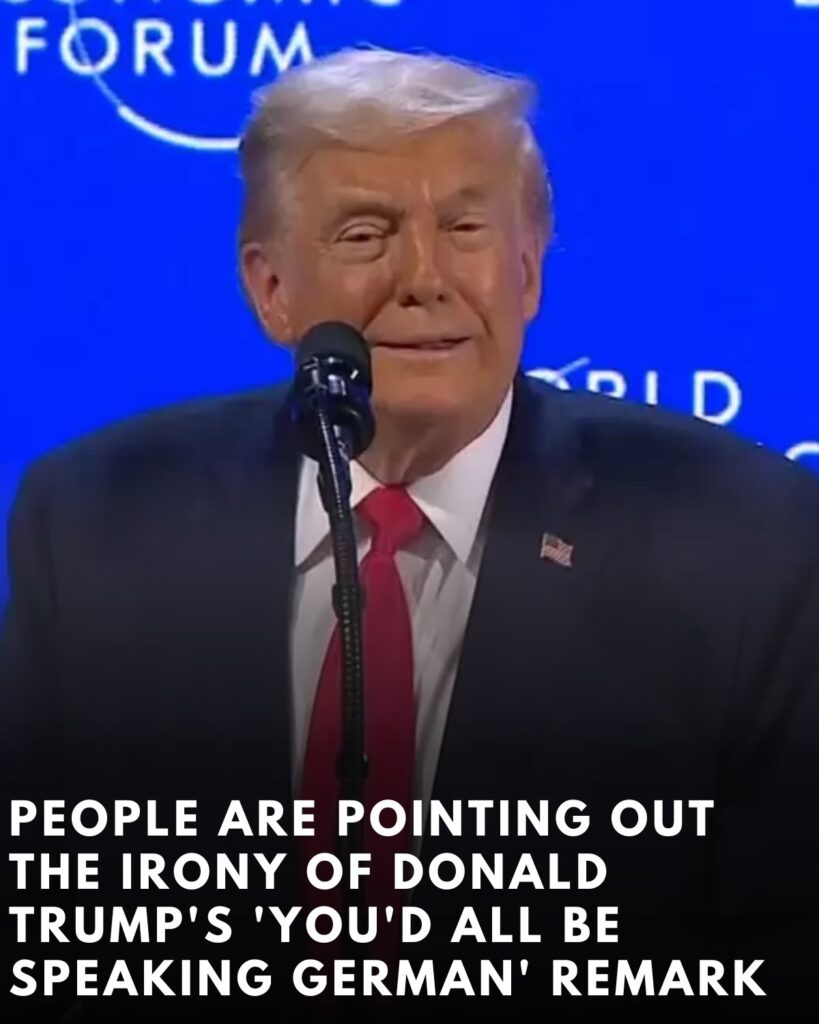
Donald Trump has faced criticism after telling an audience at the World Economic Forum in Davos that, without the United States, Europeans “would all be speaking German and a little Japanese”, a remark that drew an immediate backlash online and renewed scrutiny of the US President’s broader message on Europe, NATO and his administration’s stated ambition to bring Greenland under American control.
Trump made the comment during a wide-ranging address in the Swiss Alps on Wednesday, during which he argued that European countries had weakened themselves through energy and economic policies and said the United States had repeatedly acted to protect the continent’s security. The President used the speech to press his case that Washington should lead on Greenland’s security and suggested the territory’s strategic importance had grown, framing the issue as a matter of national and international defence.
In the section of his remarks that prompted the strongest reaction, Trump referenced World War Two and Denmark’s occupation by Nazi Germany, arguing that US actions in the conflict and in the North Atlantic created a continuing obligation that Denmark and Greenland should recognise. “Without us, right now, you’d all be speaking German and a little Japanese, perhaps,” he said, before criticising the post-war decision not to retain Greenland. “After the war, we gave Greenland back to Denmark. How stupid were we to do that?” he added.
The line was widely shared on social media, where some users described it as offensive and others seized on what they said was the irony of making a sweeping point about language while speaking in Switzerland, a country with multiple official languages and a significant German-speaking population. One person wrote on X: “They do speak German in Davos. Not that he’d know that.” Another posted: “When he is standing in a German speaking country…”
Switzerland has four national languages: German, French, Italian and Romansh. German is the most widely spoken, and the region around Davos, in the canton of Graubünden, includes German as an official language alongside Romansh and Italian at cantonal level.
Trump’s speech, which ran for more than an hour, mixed comments about Europe’s energy mix and industrial competitiveness with a warning that the United States would not forget how allies respond to what he cast as US security priorities. The President argued that NATO members should back the US approach to Greenland, saying it would strengthen the alliance rather than undermine it, and presented the issue as one where American military capabilities were uniquely decisive.
In Davos, Trump described Greenland as “a vast, almost entirely uninhabited and undeveloped territory” in a crucial location between major powers, calling it central to US security planning. He said “no nation, or group of nations, is in any position to be able to secure Greenland other than the United States”, and linked his argument to Denmark’s rapid defeat in 1940.
He also deployed more provocative language, describing Greenland as a “big, beautiful piece of ice” and saying, “We want a piece of ice for world protection, and they won’t give it,” as he pressed the case for American control. He told the audience that NATO nations had “a choice”, adding: “You can say yes, and we will be very appreciative. Or you can say no, and we will remember.”
The controversy over the language remark quickly became entwined with criticism of Trump’s broader telling of World War Two and the post-war settlement, with some commentators pushing back on the suggestion that the US “won” the war in a way that entitled it to reshape European territory decades later. LADbible reported that some users accused the President of attempting to “rewrite history” and questioned his understanding of geography and Europe’s languages.
The exchange reflects how Trump’s public statements, particularly on European security and historical memory, can trigger rapid and polarised reactions online, even as his administration attempts to advance a high-stakes diplomatic agenda. In Davos, the President repeatedly returned to the theme that the United States had provided decisive support to Europe and should now expect alignment on issues it frames as strategic, including Greenland.
While social media criticism focused on the tone and implications of the “speaking German” line, the context of the comment, according to the transcript of Trump’s address published by the World Economic Forum, was a broader argument that the US should have kept Greenland after World War Two and that the territory’s importance has increased in the modern era. Trump said American presidents had sought to purchase Greenland for “nearly two centuries” and claimed it was part of North America on the “northern frontier of the Western Hemisphere”, framing the issue as one of hemispheric defence.
The White House has not, in the material published alongside the Davos remarks, addressed criticism of the language comment. But the controversy is likely to add pressure on US officials trying to keep the Greenland discussion focused on security claims and diplomatic process rather than rhetorical flare-ups, at a time when Trump is also pushing European governments on energy policy, defence spending and broader alignment with Washington’s priorities.