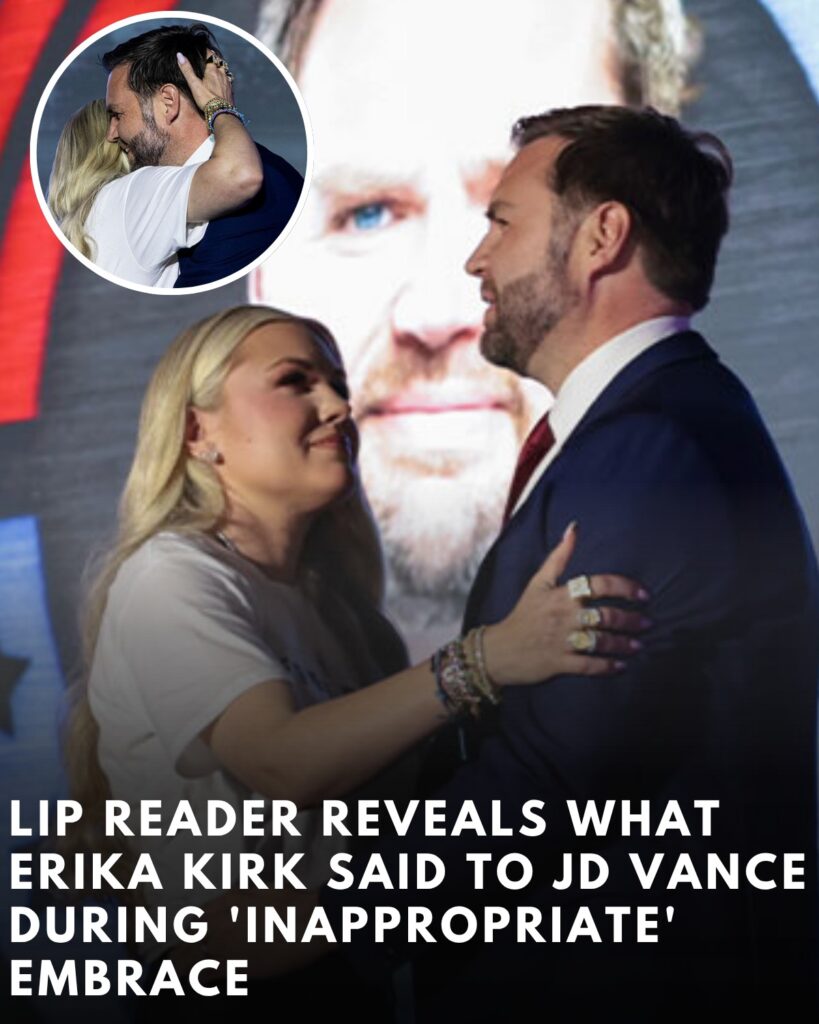
The on-stage embrace between Erika Kirk and US vice president JD Vance at a Turning Point USA event in Mississippi has triggered a wave of scrutiny, armchair analysis and speculation that has rapidly spilled from political circles into the broader culture war online. What began as a brief greeting after a memorial-tinged introduction has since been slowed down, screen-grabbed and forensically examined by social media users and commentators, prompting interventions from professional lip readers and body-language analysts and a subsequent public response from Kirk herself. The episode, which occurred seven weeks after the assassination of her husband, conservative activist Charlie Kirk, has become a flashpoint in a fraught moment for the movement he founded and that she now leads.
The encounter took place on 29 October at the University of Mississippi, where Vance appeared as a guest speaker during a Turning Point USA event that doubled as a showcase for the organisation’s future under Kirk’s stewardship. In introducing Vance, Kirk told the audience that she had prayed about asking the vice president to appear, and then referenced her late husband in terms that immediately reverberated online. “No one will ever replace my husband but I do see some similarities of my husband in Vice President JD Vance,” she said, according to footage circulated from the event.
When Vance joined Kirk on stage, the pair shared a lingering hug. Video and photos show Vance’s hands placed at Kirk’s waist while she cupped the back of his head, her fingers briefly raking his hair. Within hours, the clip was being replayed across X and TikTok, while still images — often stripped of the surrounding context and the sequence of movements — became fodder for claims that the greeting was inappropriately intimate given the circumstances and that it raised questions about both figures’ judgement. Others defended it as a human moment between two people processing grief within a highly public setting.
As the argument escalated, a fresh layer of commentary emerged in the form of lip-reading claims about what the two said to each other in the few seconds after they separated. Multiple entertainment outlets, citing a professional lip reader, reported that Vance told Kirk, “I’m proud of you,” and that Kirk replied, “It’s not gonna bring him back.” The attribution for that exchange traces to a lip reader identified as Nicola Hickling, who was quoted by Mirror USA and relayed in subsequent coverage. These accounts, while widely shared, rely on non-official audio interpretation of silent footage, and they have not been corroborated by either Vance or Kirk.
The wider context of the event helps explain both the intensity of the reaction and the emotive tenor of Kirk’s remarks. Charlie Kirk, Turning Point USA’s co-founder and figurehead, was shot dead on 10 September while speaking at a university event in Utah. In the weeks since the killing, Erika Kirk has taken on a more public role, assuming leadership at TPUSA and appearing at memorial and movement events while also navigating decisions around the impending criminal proceedings against the accused shooter. Her public statements have blended tributes to her husband with calls for transparency in the legal process and a determination to continue the organisation’s work.
In the days after the Mississippi event, Kirk appeared in a Fox News interview preview clip and separate social media messages to address the swirl of attention. She argued for cameras to remain in the courtroom when the case against the suspect proceeds, saying that transparency would serve the public interest and honour the gravity of what occurred. “There have been cameras all over my friends and family, mourning. There have been cameras all over me — analysing my every move, my every smile, my every tear,” she said, before adding, “Why not be transparent? There’s nothing to hide. Let everyone see what true evil is.” Kirk grew visibly emotional when shown a tribute video, quietly asking for a moment to compose herself.
At the Mississippi event itself, Vance spoke at length about faith and family after taking the stage. Responding to a question about religion in his household, he remarked that his wife, Usha, was raised in a different faith and that their family had chosen to raise their children Christian; he expressed hope she might one day share his beliefs, while emphasising their relationship and the freedom of conscience. Those remarks, made as part of an audience Q&A, have been pulled into the broader online discourse around the hug, with some users tying them — sometimes tendentiously — to claims about the pair’s relationship. The comments, while drawing attention for their frankness about interfaith family dynamics, do not themselves assert anything beyond Vance’s public description of his home life.
The tug-of-war over interpretation of the hug has followed a now-familiar digital pattern. Short clips and selected angles were first pushed by accounts aligned with different political tribes, followed by reaction videos and commentary posts emphasising either impropriety or empathy. Some social media users suggested the body language — the hand at the back of the head, the closeness of the torsos, the placement of the hips — signalled something more than a consoling embrace; others argued the moment had been wilfully misread, noting that still photos can exaggerate the sense of intimacy compared with full-speed footage. Body-language specialists quoted in subsequent media pieces framed the touchpoints as highly intimate gestures but stopped short of drawing conclusions about intent, highlighting instead the intensity of the grief and the performative pressures of public mourning.
What is uncontested is that the moment landed amid an unusually combustible backdrop. Turning Point USA is attempting to project continuity and resilience after the killing of its founder. Erika Kirk’s leadership — and her visibility — are bound up with that strategy, making appearances like the Oxford, Mississippi event both symbolic and fraught. Vance, for his part, is balancing the demands of high office with the project of coalition-building across the conservative movement’s institutions, and he arrived on stage with the star power and scrutiny that entails. The optics of their greeting therefore took on an outsized significance: intimate enough to prompt commentary, public enough to be captured from multiple angles, and ambiguous enough to serve as a canvas for projection by supporters and critics alike.
In the absence of official transcripts or hot-mic audio, the most definitive words attached to the scene remain those spoken audibly by Kirk at the lectern before the hug, when she invoked her husband and linked Vance to him in mission and character. “When our team asked my dear friend, Vice President JD Vance, to speak today, I really prayed on it,” she told the crowd. “But I could just hear Charlie in my heart … ‘Go reclaim that territory, babe. Go. The battle’s already won. God’s love conquers’.” That tribute, delivered through tears at points, prefaced her declaration that “no one will ever replace” Charlie even as she perceived “some similarities” in Vance. It was an attempt to honour the past while gesturing towards the future; it also laid the groundwork for the emotional register in which the hug was received.
The reaction has ranged from sympathy to derision. A subset of conservative commentators and influencers criticised the embrace as unbecoming or disrespectful, with some amplifying unverified claims about the pair’s personal lives; others within the same orbit urged restraint, describing the moment as an understandable lapse into human connection under extraordinary stress. On the other side of the political aisle, left-leaning users alternated between mockery and concern, while a handful of centrist voices implored audiences to step back from insinuation and remember that a homicide lies at the heart of this story. What emerges, as with so many viral controversies, is less a consensus about what happened than a mirror of the audience’s predispositions.
Even the lip-reading claims have become part of that contest. The reported exchange — Vance saying “I’m proud of you” and Kirk replying “It’s not gonna bring him back” — is consistent with the emotional logic of the event, and it has been widely circulated. But it remains an inference from visual footage rather than an on-the-record statement. Several outlets framed the reading cautiously, and none of the principals have confirmed the lines. Viewers who are persuaded by the reading tend to see it as evidence of a consoling dynamic; sceptics insist that the absence of audio or confirmation leaves room for doubt. For now, the words retain the status of plausible but unverified colour rather than integral fact.
Kirk’s own public posture since the embrace has been to emphasise fortitude and transparency. In her televised comments trailing the full Fox interview, she said the family “deserve to have cameras” in the courtroom, arguing that public broadcast would reveal “true evil” and serve as a deterrent. She also described the personal toll of being under sustained observation since the shooting, saying her expressions and movements had been catalogued and dissected in ways that felt invasive. The irony is stark: a widow appealing for the public to see unfiltered evidence in a murder trial finds herself at the centre of a parallel proceeding in the court of viral opinion, where context is easily lost and the incentive is to heighten, not to clarify.
Vance, meanwhile, has not publicly addressed the embrace beyond his participation at the event. His appearance at Ole Miss formed part of a broader media and movement itinerary that included Fox News coverage and a Fox Nation documentary tracking Kirk’s transition into leadership. Those productions were scheduled before the hug became a story in its own right, but their existence underscores how tightly bound the personal, the political and the performative have become in this chapter of the movement’s life.
That intermingling is unlikely to recede. The criminal case will proceed on its own timeline, and with it renewed attention to the last months of Charlie Kirk’s life and the institutional ambitions of Turning Point USA without him. As those milestones arrive, moments like the Mississippi embrace will be revisited by partisans seeking patterns and by audiences wrestling with how public grief should look when it unfolds under stage lights. The footage from the Oxford arena will remain available for anyone to interpret — a looped fragment of a complicated day in a complicated season, treated as evidence by some and as a Rorschach test by others. What can be said with confidence is limited but significant: Erika Kirk eulogised her husband, linked her organisation’s mission to the vice president’s support, and, on greeting him, embraced him closely; the images sparked intense debate; a lip-reader’s account of a consoling exchange circulated widely; and Kirk subsequently used her platform to call for courtroom transparency and to describe the toll of being watched. Beyond that, the meaning attached to those seconds will continue to reflect the viewers more than the video.
As a matter of record, none of the individuals involved has alleged misconduct by the other, and the most detailed direct quotations available come from Kirk’s prepared and televised remarks rather than from the silent moments captured on stage. That distinction matters, particularly in an era where inference often outruns evidence. It is possible that at some future point Vance or Kirk will offer a definitive account of their words and intentions in Mississippi. Until then, the story remains what the documented record supports: a high-profile public figure introduced a political ally with language that invited comparison to her murdered husband; the subsequent embrace, captured in close-up and shared at scale, ignited a bitter online argument; professionals and amateurs alike parsed posture and lips for meaning; and the widow at the centre of it all urged a different kind of scrutiny, asking that cameras be trained on a courtroom where the killing itself will be examined in full view.