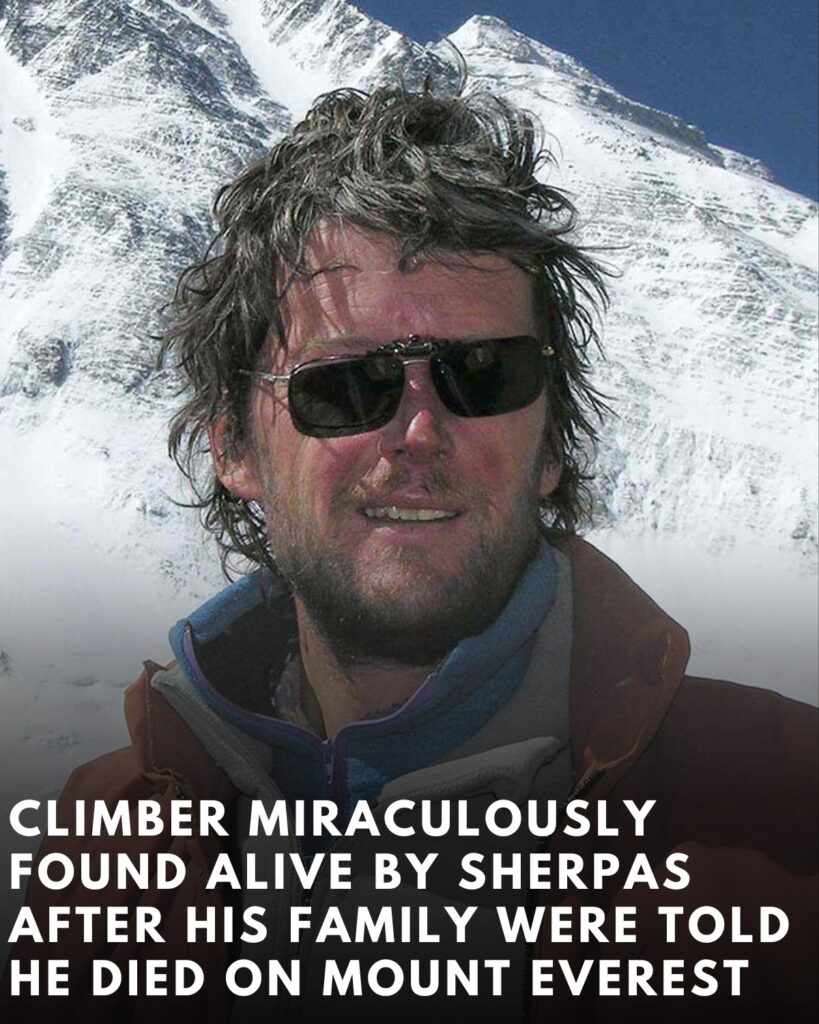
n Australian climber who was declared dead on Mount Everest was later discovered alive in one of the most astonishing survival stories in mountaineering history. Lincoln Hall, a 50-year-old mountaineer from Canberra, had been reported to have died near the summit of the world’s highest mountain in May 2006, only for rescuers to find him the next morning sitting upright in the snow — frostbitten, disoriented, but alive.
Hall’s ordeal began during his descent from the 8,848-metre summit, after successfully reaching the top with a team of climbers and Sherpa guides. At an altitude of around 8,600 metres — inside the so-called “death zone,” where oxygen levels are critically low and human survival becomes severely limited — Hall began showing signs of altitude sickness and cerebral edema, a dangerous swelling of the brain caused by lack of oxygen.
Sherpas assisting him tried for hours to help him down, but his condition deteriorated rapidly. He became incoherent and eventually collapsed. Believing that he had died, the expedition leader radioed base camp to report his death, and Hall’s family in Australia was informed that he had perished. Climbers nearby at the time described the decision as a tragic but necessary one, given the life-threatening conditions and the impossibility of carrying an apparently lifeless body down from such extreme heights.
Yet, against all odds, Lincoln Hall did not die. After spending a night alone in temperatures that dropped well below minus 30 degrees Celsius, he regained consciousness the following morning. Still suffering from frostbite and oxygen deprivation, he managed to sit up near the edge of a ridge at around 8,600 metres — a place where most climbers can survive only minutes without supplemental oxygen.
Later that morning, another climbing team led by American mountaineer Dan Mazur was making its own summit attempt when they spotted something extraordinary. Sitting cross-legged near a sheer drop, his down suit unzipped and no gloves or hat in sight, was Lincoln Hall. Mazur later described the moment of disbelief when he realised the man in front of him was not only alive but speaking coherently. Hall, weak but conscious, reportedly greeted them by saying, “I imagine you’re surprised to see me here.”
Mazur and his team immediately abandoned their summit bid to try to save Hall’s life. They gave him food, water, and oxygen, while sending urgent messages down the mountain to organise a rescue. A team of Sherpas was dispatched from base camp, climbing through the night to reach him. Over several exhausting hours, they assisted Hall down through the death zone and towards Camp IV, the highest permanent camp on the mountain.
News of his survival quickly spread, first through mountaineering radio networks and then around the world. Only hours earlier, Hall’s family in Australia had been mourning his death after being told that efforts to save him had failed. Now, they were receiving messages that he had been found alive and was being brought down the mountain. The turnaround was so extraordinary that even seasoned climbers struggled to believe it at first.
When Hall eventually made it to safety, he was suffering from severe frostbite, dehydration, and altitude-induced brain swelling. Doctors who treated him in Kathmandu said it was almost impossible that he had survived the night at such an altitude without oxygen. Many who heard his story called it a miracle.
After recovering, Hall returned home to Australia, where he continued to work as a writer, lecturer, and advocate for responsible mountaineering. He later published a book detailing his experience, describing moments of vivid hallucination and near-death clarity during the night he spent alone on Everest. His story became symbolic of both the dangers of extreme altitude climbing and the extraordinary resilience of the human body under unimaginable stress.
The incident also reignited debate about the ethics of high-altitude mountaineering, particularly regarding the decisions climbers face when others are in distress. In Hall’s case, his rescuers were praised for sacrificing their own summit attempt to save him — a choice that contrasted with several controversial incidents in which climbers had passed by dying mountaineers to pursue their ascent.
Lincoln Hall’s survival remains one of the most remarkable stories ever to emerge from Mount Everest. He defied not only the expectations of his team and the brutal realities of the death zone but also the physical limits of human endurance. In later interviews, he said his strongest memory from that night was the surreal feeling of floating between life and death, a sensation that stayed with him long after his rescue.
Hall continued to lead an active life for several years after the incident, speaking publicly about his experiences and using his platform to support environmental and adventure causes. In 2012, he died peacefully at the age of 56 after a battle with mesothelioma, a cancer linked to asbestos exposure earlier in his life.
His miraculous survival on Mount Everest remains an enduring reminder of both the peril and the profound beauty of human resilience — a story of a man who was pronounced dead at the roof of the world, only to awaken alone in the thin air above the clouds and live to tell the tale.