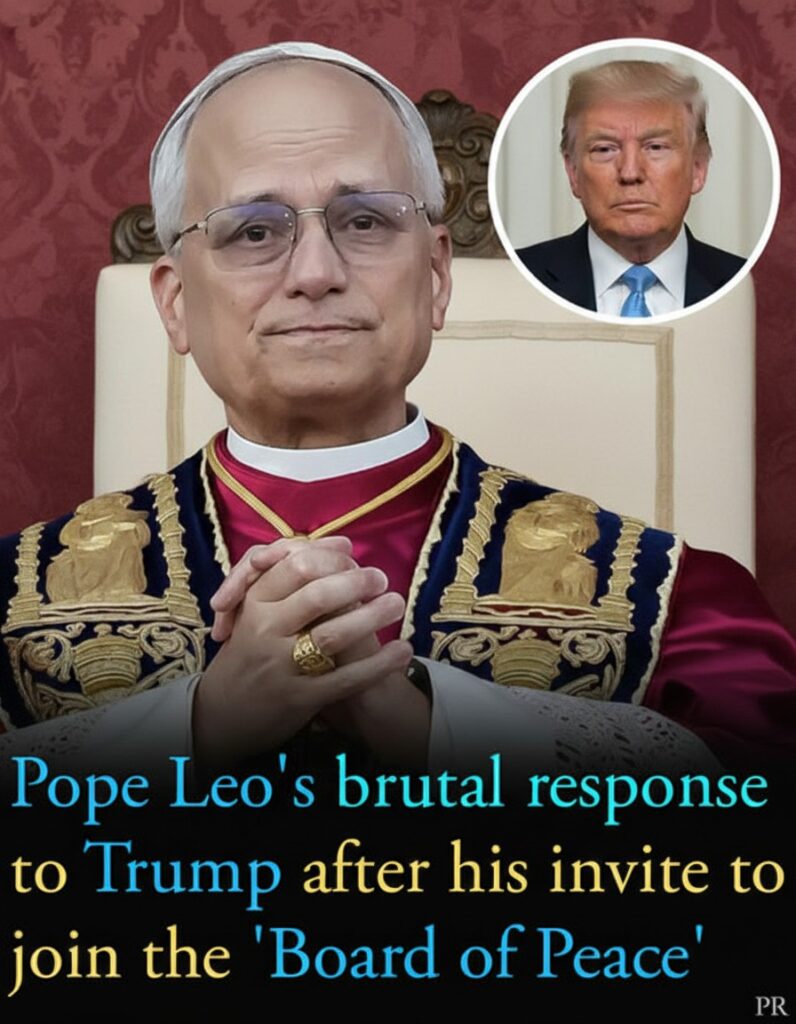
President Donald Trump recently announced the formation of what he described as a “Board of Peace,” an initiative he said was designed to address ongoing global conflicts. Presenting the proposal as a bold diplomatic effort, Trump explained that the board would focus on promoting stability in regions facing severe unrest, including Gaza. He framed the initiative as a proactive alternative to existing international mechanisms, inviting a number of nations to participate as permanent members. In a move that drew particular attention, Trump also extended an invitation to Pope Leo, the head of the Roman Catholic Church, signaling that he hoped to include moral and spiritual leadership in the effort.
The proposal, however, quickly sparked mixed reactions across the international community. Membership in the Board of Peace would require a financial contribution of $1 billion, a condition that immediately raised concerns among several governments. A number of prominent nations — including Germany, Canada, France, Italy, Norway, Sweden, the United Kingdom, and Ukraine — declined the invitation to join. Their refusal suggested hesitation about either the structure, the financial requirement, or the political implications of participating in a board led by the United States.
At the same time, other countries signaled their willingness to take part. Israel, Argentina, Russia, Hungary, and Saudi Arabia accepted Trump’s invitation and agreed to join the initiative. Their participation gave the proposed board an initial base of support, though the division among global powers highlighted the controversial nature of the plan. The contrasting responses underscored broader geopolitical alignments and differences in how nations view alternative diplomatic frameworks outside established international institutions.
When the initiative was first unveiled in January, Trump’s invitation to Pope Leo drew particular interest. As the spiritual leader of more than a billion Catholics worldwide, the Pope’s involvement could have lent significant moral authority to the project. Initially, the Vatican did not provide an immediate answer. Officials stated that Pope Leo was considering the proposal carefully and would take time before making a decision, signaling that the matter was being treated with seriousness.
In the months that followed, however, the Vatican clarified its position. Reports indicated that Pope Leo ultimately declined the invitation. According to accounts from Vatican officials, his response was firm and conveyed clear reservations about the structure and premise of the initiative. The decision reflected deeper concerns about how global conflicts should be addressed and who should lead such efforts.
Cardinal Pietro Parolin, the Vatican’s chief diplomat, explained that Pope Leo believes conflicts such as the situation in Gaza should be managed through established multilateral institutions, particularly the United Nations. From the Vatican’s perspective, peace efforts are best conducted through inclusive international cooperation rather than through a board spearheaded by a single nation. The rejection marked a significant moment, emphasizing the Holy See’s commitment to traditional diplomatic channels and multilateral engagement in matters of global peace.