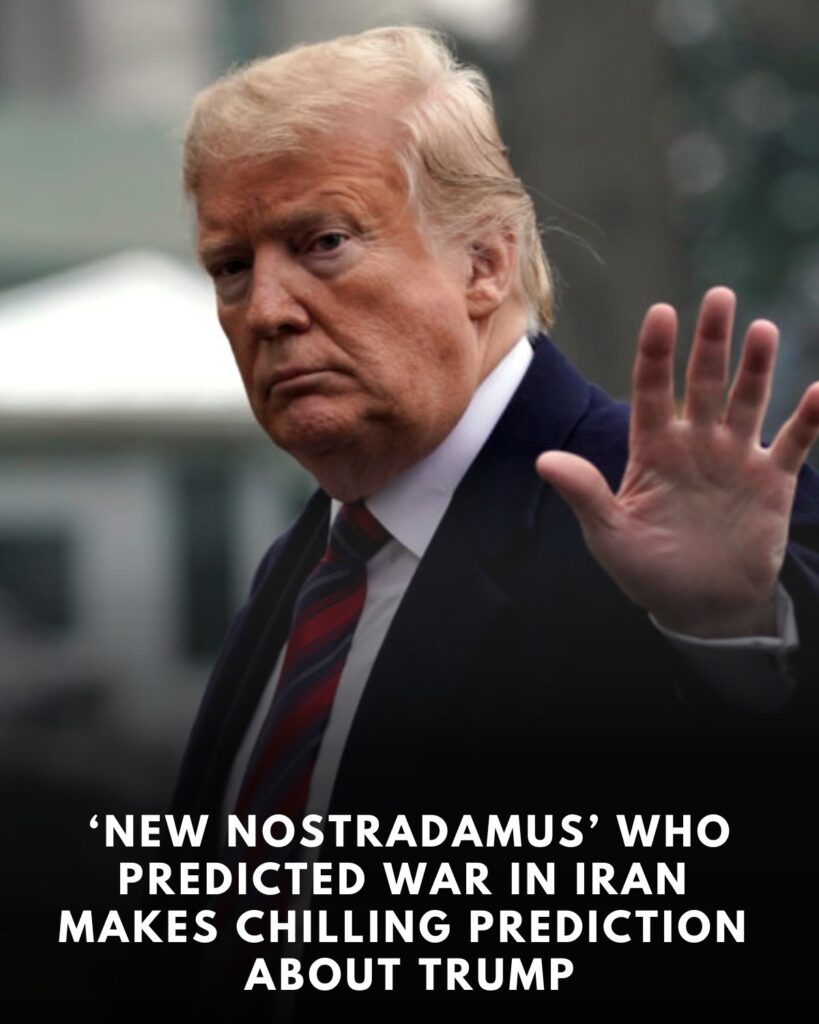
A British psychic who has built an online following by claiming to have foreseen major world events is now warning that Donald Trump could remain in power beyond the constitutional limit of two elected terms, a prediction he has tied to widening international conflict and what he describes as a period in which normal political rules could be upended. The claim, now circulating widely online, comes from Craig Hamilton-Parker, who has been dubbed the “New Nostradamus” in tabloid coverage and who says the present crisis involving Iran fits into a broader vision he has been outlining for 2026.
Hamilton-Parker’s latest forecast, as reported by VT and the Daily Express US on March 17, centres on the idea that Trump could somehow secure or exercise a third term as president, despite the fact that the 22nd Amendment to the US Constitution explicitly says no person shall be elected president more than twice. The psychic reportedly argued that a major global conflict could create conditions in which the established order is disrupted. In comments quoted by those reports, he said he had long felt there would be a major international crisis, possibly involving Taiwan, but now believed the same sense of upheaval could apply to other flashpoints, including the Middle East.
His comments have been linked directly to the worsening confrontation around Iran. VT reported that Hamilton-Parker has claimed recent developments in the region support his earlier warnings. The same report placed his prediction alongside Trump’s latest remarks about the Strait of Hormuz, where the US president has urged allies and other major powers to help secure one of the world’s most important oil routes. In comments quoted by VT, Trump said it was “only appropriate” that states benefiting from the strait should help ensure that “nothing bad happens there”, and warned that a negative response from allies would be “very bad for the future of NATO”. He also said China should help because it receives the bulk of its oil through the passage.
That regional backdrop is not theoretical. Reuters reported on March 11 that Trump told Axios the war in Iran would end soon and claimed there was “practically nothing left” to target. That report described an intensifying conflict in which the United States and Israel had been carrying out strikes aimed at Iran’s military capabilities and nuclear programme, with Trump presenting the situation as something he could effectively bring to a close at will. The existence of an active military confrontation has helped fuel renewed attention to apocalyptic predictions, particularly those circulating on social media and on fringe YouTube channels.
Hamilton-Parker’s prediction about Trump is striking partly because it collides so directly with US law. The 22nd Amendment, ratified in 1951 after Franklin D Roosevelt’s four election victories, states that no person shall be elected to the presidency more than twice. Reuters noted in 2025 that Trump himself had at one stage said he was “not joking” about the possibility of a third term, raising alarm by saying there were “methods” by which it could be done. That comment was widely interpreted as an attempt to test the boundaries of political discourse, even though legal scholars made clear that the constitutional bar is direct and formidable.
At the same time, the public record around Trump’s own position has not been entirely consistent. Reuters reported in October 2025 that Trump later said US law prevented him from running for a third term and indicated he would not do so, though that statement came only after months in which the idea had been repeatedly floated by allies and by Trump himself. Sky News also reported in February 2026 that one Republican congressman, Andy Ogles of Tennessee, had proposed amending the Constitution to allow three non-consecutive terms, a route that would in theory benefit Trump because his two presidencies were not consecutive. But that proposal was described as virtually impossible to achieve, given the supermajorities required in Congress and among the states.
The psychic’s argument, however, does not appear to depend on conventional legal procedure. According to the Daily Express US, Hamilton-Parker said “something will occur that overturns the existing rules, and that period will be a time of great conflict.” He reportedly framed his forecast in terms of emergency powers and an international environment in which events that currently seem implausible could quickly become possible. He also pointed to wider geopolitical instability, citing the speed with which unthinkable scenarios have become part of mainstream political discussion. Those are his claims rather than independently verified political forecasts, but they have become central to the latest round of coverage surrounding him.
Hamilton-Parker is not a mainstream political analyst, diplomat or constitutional scholar. He is a self-described psychic medium who runs a YouTube channel and works with his wife Jane, drawing in part on spiritual readings and the Indian tradition of Nadi astrology. VT and the Express both describe him as having built a brand around predictions involving geopolitics, natural disasters and public figures. His supporters often credit him with having foreseen Brexit, Covid-19, Queen Elizabeth II’s death and Trump’s original 2016 election victory, although such claims are typically presented by him and sympathetic media rather than established by any formal or independent standard of verification.

That profile helps explain why his remarks keep surfacing during moments of crisis. When tensions rise, particularly in war or election years, interest in prophecy tends to intensify. Nostradamus, Baba Vanga and a rotating cast of contemporary seers are repeatedly brought back into public conversation whenever a real-world event appears to echo something vague or ominous said earlier. In Hamilton-Parker’s case, the Iran conflict has provided that opening. Reports published in early March said he had been warning of direct strikes on Iran’s military and nuclear facilities and later claimed that events had vindicated him. Those claims are part of his public persona, though they remain assertions made by him and by coverage amplifying him, rather than findings grounded in conventional evidence.
What makes the Trump element more sensitive is that it touches on a real political anxiety inside the United States. Trump’s earlier flirtation with the idea of a third term was not treated merely as a joke by critics, because it came at a time when democratic norms, presidential power and constitutional guardrails were all under intense scrutiny. When a president publicly says there may be “methods” to stay in office beyond the normal limit, even if later walked back, that remark becomes fertile ground for speculation. Hamilton-Parker’s forecast slots directly into that unease, taking a genuine constitutional controversy and recasting it as a prophetic warning about what war and emergency politics might make possible.
For now, there is no evidence that Trump can lawfully obtain a third elected term under the Constitution as it stands, and no verified mechanism has emerged that would make Hamilton-Parker’s prediction a practical reality. But the story has travelled because it sits at the intersection of several forces already driving public attention in 2026: fear of wider war, concern over executive power, Trump’s own past remarks about staying in office, and the enduring appetite for prophecy during periods of instability. As fighting involving Iran continues to dominate headlines and as Trump keeps speaking in maximalist terms about America’s ability to impose its will abroad, Hamilton-Parker’s comments are likely to keep circulating, not because they are grounded in legal certainty, but because they tap into a moment in which uncertainty itself has become part of the political atmosphere.