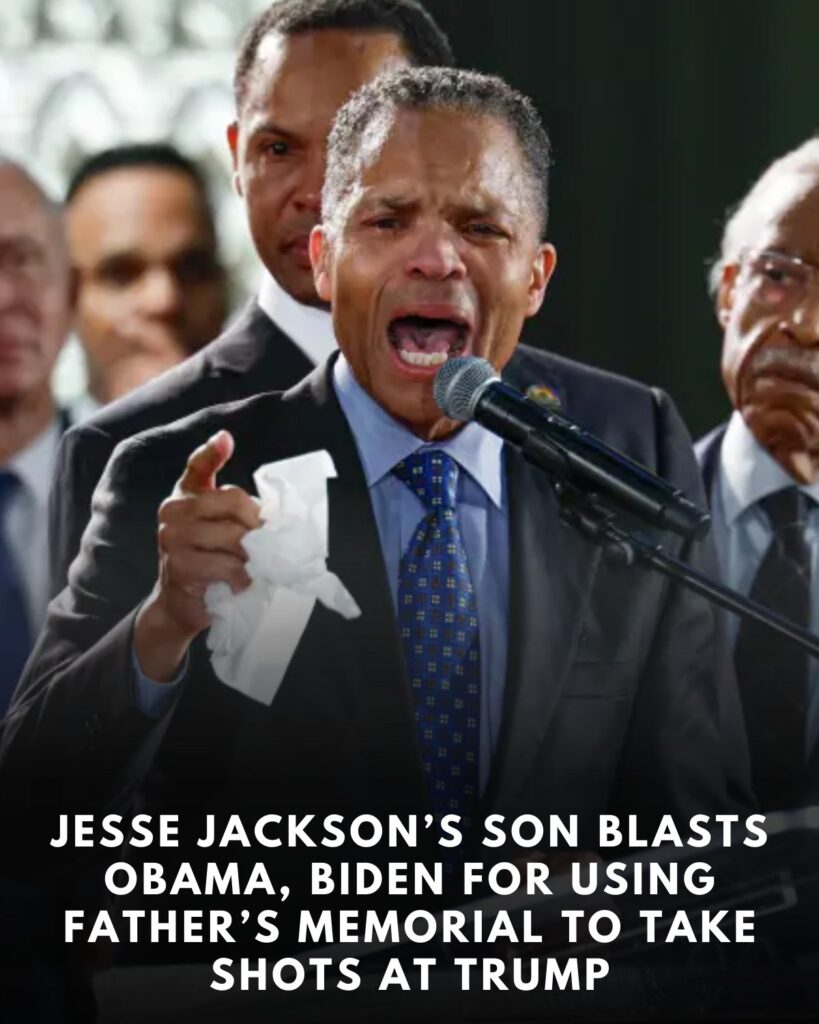
The late Rev. Jesse Jackson’s final memorial events in Chicago, intended as the closing chapter in a week of tributes to one of the most influential civil rights leaders in modern American history, instead exposed a public split over how his life should be remembered. At a private service on Saturday at the Rainbow PUSH Coalition headquarters, his eldest son, Jesse Jackson Jr., sharply criticised the tone taken by several Democratic heavyweights at the previous day’s nationally televised memorial, saying the political messages delivered by Barack Obama, Joe Biden and Bill Clinton did not reflect the essence of his father’s life or work. According to remarks reported from the service, Jackson Jr. said: “Yesterday, I listened for several hours to three United States presidents who do not know Jesse Jackson,” before arguing that his father’s relationship with power was always uneasy and rooted not in party loyalty but in advocacy for those shut out of American life.
His intervention landed after a high-profile public memorial on Friday at Chicago’s House of Hope, where three former presidents, former vice-president Kamala Harris and a host of political and civil rights figures gathered to celebrate Jackson’s legacy. That event drew thousands and became not only a remembrance of Jackson’s long public life but also, at moments, a pointed commentary on the country’s political climate under President Donald Trump. Reuters reported that Obama told mourners the United States faced “some new assault on our democratic institutions” each day, while Biden said the Trump administration did not share “the values that we have.” Harris also used her remarks to look at the present political moment, saying she had seen much of what is now happening coming, while Clinton’s speech was described by several reports as more personal and largely less political than the others.
For Jackson Jr., the issue was not simply that politics had entered the room, because politics had shaped his father’s entire life. It was that he believed the speakers had reduced Jesse Jackson to a vehicle for current partisan argument rather than grappling with the harder, broader and more complicated role he played in American life. In the private memorial remarks, Jackson Jr. said his father “maintained a tense relationship with the political order,” not because presidents were white or Black, Democrat or Republican, but because “the least of these” demanded a “consistent, prophetic voice” that never sold people out. That language echoed a warning he had already issued shortly after his father’s death, when he publicly asked those attending the services to leave party divisions outside and come “respectful” to honour Jackson’s life.
That argument goes to the heart of why Jesse Jackson remained such a singular and sometimes unsettling figure across more than half a century in public life. Born in Greenville, South Carolina, in 1941, Jackson rose from the segregated South into the front ranks of the civil rights movement, becoming a close associate of Martin Luther King Jr. and working in the Southern Christian Leadership Conference. He was with King in Memphis on the day of the assassination in 1968, an event that shaped the rest of his life and public identity. In the years that followed, Jackson built Operation PUSH and later the Rainbow Coalition, using boycotts, negotiation, religious rhetoric and electoral organising to pressure corporations, institutions and political leaders to open doors to Black Americans and other excluded groups.
He was never easy to classify. Jackson was a preacher, activist, dealmaker, protest leader and presidential candidate, often all at once. His 1984 and 1988 campaigns for the Democratic nomination did not win the presidency, but they fundamentally altered the terrain on which American politics was fought. Reuters noted that he became the most successful Black presidential candidate of his era, while Obama, in his memorial remarks, credited Jackson’s 1988 campaign with helping create the political path that later made his own rise possible. Jackson’s “Rainbow” politics attempted to bind together Black voters, labour, the poor, progressives and other groups on the margins, and his language about dignity and representation became part of the vocabulary of modern Democratic politics even when party leaders were not always comfortable with him.

Even in death, Jackson’s ability to cross and complicate party lines remained evident. Trump did not attend the Chicago memorial, but after Jackson died on 17 February at the age of 84, he issued a tribute describing him as a “force of nature” and, in later public remarks, called him “a real hero.” At the same time, Trump also used his statement to take aim at Barack Obama, underscoring the way Jackson’s legacy continues to be pulled into present political battles. Reports from the memorial week showed honours coming from across the political spectrum as well as from civil rights leaders, foreign officials and ordinary supporters who had seen Jackson as a symbol of hope, pressure and persistence for decades. That breadth is part of what made Jackson Jr.’s complaint so striking. It was not just a son grieving. It was a public insistence that his father belonged to a wider history than any one faction could claim.
The memorials themselves reflected the scale of Jackson’s reach. The public service at House of Hope drew former presidents, clergy, activists and thousands of mourners, while the more intimate gathering at Rainbow PUSH, reported by the Associated Press, brought together family, close associates and international voices, including leaders who spoke of Jackson’s role in the anti-apartheid movement and in global justice campaigns. Jackson’s children and fellow activists used the final event not merely to close a week of mourning but to urge supporters to continue the work he spent decades advancing, from voting rights to economic justice and peace efforts abroad. In that sense, the conflict over tone was also a conflict over inheritance: whether Jackson should be remembered chiefly as an inspiration for current Democratic resistance to Trump, or as an independent moral and political force whose career often challenged both parties and every established centre of power.
That tension had always surrounded Jesse Jackson. Admirers saw him as a relentless voice for people ignored by institutions, while critics sometimes viewed him as theatrical, opportunistic or too willing to insert himself into every national drama. Yet few disputed his impact. He helped keep civil rights politics alive after King’s death, pushed corporate America on minority hiring, ran barrier-breaking presidential campaigns, intervened in international hostage crises and stayed publicly engaged deep into old age, even after revealing a Parkinson’s diagnosis in 2017 and later facing more serious health problems. By the time Chicago gathered to say goodbye, Jackson had become both a historical figure and a living argument about what prophetic leadership looks like in American politics. His son’s remarks ensured that argument did not end at the graveside. Instead, they served as a reminder that for those closest to him, Jesse Jackson was not simply a Democratic icon or a convenient symbol for the present moment, but a man whose life was defined by struggle, friction and a refusal to let power go unchallenged.