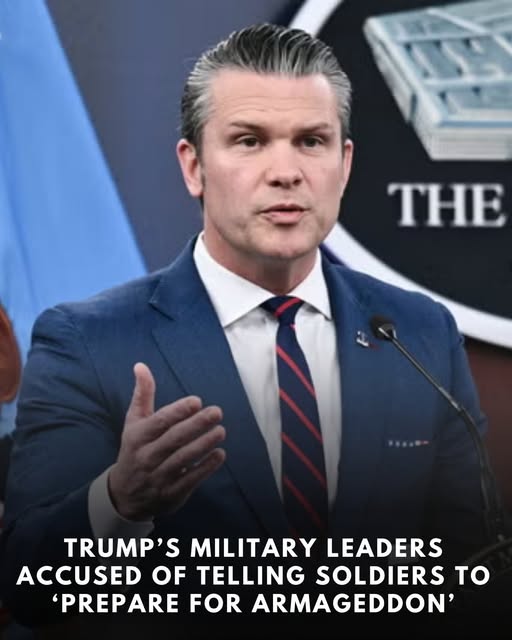
The Military Religious Freedom Foundation (MRFF), an advocacy group that campaigns against unlawful religious coercion in the US armed forces, says it has received a surge of complaints from service members alleging that commanders framed the current US military operations against Iran in explicitly Christian end-times terms, including references to Armageddon and the return of Jesus Christ.
In a post published on its website, the MRFF said it had received “over 200 calls from more than 50 military installations across all the services” since Saturday, describing what it called “similar disturbing pronouncements” made by commanders. The organisation published what it described as an account from an active-duty non-commissioned officer writing “on behalf of themself and 15 other unit members”, alleging that a commander used a “combat readiness status briefing” to tell troops that events unfolding in Iran were “all part of God’s divine plan”, while citing passages from the Book of Revelation.
According to the MRFF’s published excerpt, the commander allegedly urged troops “to not be ‘afraid’” and told them to “tell our troops that this was ‘all part of God’s divine plan’”, before referencing “numerous citations” from Revelation “referring to Armageddon and the imminent return of Jesus Christ.” The same excerpt attributes to the commander a further claim that “President Trump has been anointed by Jesus to light the signal fire in Iran to cause Armageddon and mark his return to Earth.”
The allegations have circulated widely online since the MRFF’s post, with some users treating the claims as evidence of religious extremism within parts of the US military command, while others questioned whether such remarks would be made openly in official briefings. The MRFF’s account, as published, does not identify the commander, the unit, or the installation involved, and it presented the excerpt as a complaint from clients who contacted the organisation for assistance.
The controversy sits within a longstanding debate in the United States over the boundary between personal faith and official conduct in the armed forces. The US military operates under constitutional constraints, including the First Amendment’s Establishment Clause, and commanders are expected to avoid actions that could be interpreted as endorsing a specific religion or pressuring subordinates to take part in religious activity. The MRFF argues that explicit religious messaging by superiors, particularly when linked to policy or military operations, can amount to coercion in a hierarchical environment where subordinates may feel unable to object.
The MRFF was founded by Michael L “Mikey” Weinstein, a former US Air Force officer, and has for years publicised complaints from service members who say they were subjected to religious proselytising or discriminatory treatment. In its latest posting, the organisation framed the alleged remarks as part of a broader pattern it describes as “Pentagon Christian nationalism”, and urged attention to what it characterised as a wave of “end-times” rhetoric connected to the Iran conflict.
In reporting on the MRFF claims, the Guardian said the organisation asserted that commanders were telling troops that the conflict with Iran was “part of God’s plan” to bring about the return of Jesus. The paper reported that the MRFF said it had been “inundated with complaints” and that those complaints came from multiple installations across different services. The Guardian account also described the MRFF’s publication of a detailed complaint that alleged the remarks were delivered during a combat readiness briefing and included references to Revelation and Armageddon.
UNILAD Tech, which linked to the MRFF claim in a widely shared Facebook post, similarly reported that military leaders had been accused of urging troops to prepare for “armageddon” and Jesus’s return, presenting the allegations as originating with the MRFF’s complaints and the account attributed to an active-duty service member.
The allegations come amid heightened attention on the role of religion in US political rhetoric and in public institutions, particularly during periods of conflict. Some evangelical Christian communities in the US have long interpreted turmoil in the Middle East through apocalyptic biblical frameworks, while critics argue such interpretations can distort policy discussions and inflame tensions. In military settings, however, the stakes are sharpened by command authority and by the requirement for government neutrality in matters of faith.
The MRFF’s post included language describing the reported remarks as coming from “Christian zealot commanders”, and it urged supporters to read further material linked from the page. Its publication drew extensive comment activity on the MRFF site itself, reflecting polarised reactions among readers, including scepticism about whether a senior leader would speak in such terms during an official briefing and pushback from others who argued that the allegations aligned with what they believe is a growing politicisation of religion.
At the centre of the dispute is the question of verification. The MRFF says it is reporting what service members told it directly, and it has historically framed its role as providing a channel for military personnel who fear retaliation if they complain through official routes. Its critics, including some current and former service members, have argued that the organisation relies on anonymous accounts that are difficult to corroborate publicly. The MRFF says anonymity is often necessary to protect complainants in a command environment.
Any formal military inquiry would typically require identifying details such as the unit, installation, and chain of command involved, as well as statements from witnesses. The MRFF’s published material, as presented, does not provide those details publicly. Nor does it include supporting documentation such as recordings, emails, or written briefing notes. The organisation’s account is framed as a complaint narrative rather than an evidentiary dossier.
Even so, the episode has reignited scrutiny of how the US military manages religious expression among leaders. The Department of Defense has, over the years, issued guidance seeking to balance the rights of service members to practise their faith with the obligation to prevent official endorsement or coercion. In practice, disputes frequently arise around the speech of commanders, chaplains, and instructors, particularly when religious language becomes intertwined with official messaging or operational objectives.
For service members who do not share a commander’s beliefs, overt religious framing of combat operations can be experienced as exclusionary or intimidating, particularly in moments of heightened risk. The MRFF argues that when senior leaders present a conflict as part of a divine plan, or suggest a political leader is “anointed” for a religious mission, it can undermine unit cohesion and violate the expectation that military authority is exercised on behalf of the state rather than a faith tradition.
The claims also risk drawing political attention at a time when the US role in Iran is already contentious. If substantiated, such remarks could prompt questions about command climate, professionalism, and the safeguards intended to keep religious belief separate from operational orders and strategic messaging. If not substantiated, the story illustrates how quickly anonymous allegations can spread across social media during moments of crisis, shaping perceptions before any official account is available.
As of the material reviewed from the MRFF and subsequent reporting, the allegations remain claims attributed to complainants, rather than findings established by an official investigation. The MRFF says complaints are continuing to arrive from different parts of the military, and its supporters are urging the Pentagon and Congress to take the issue seriously.