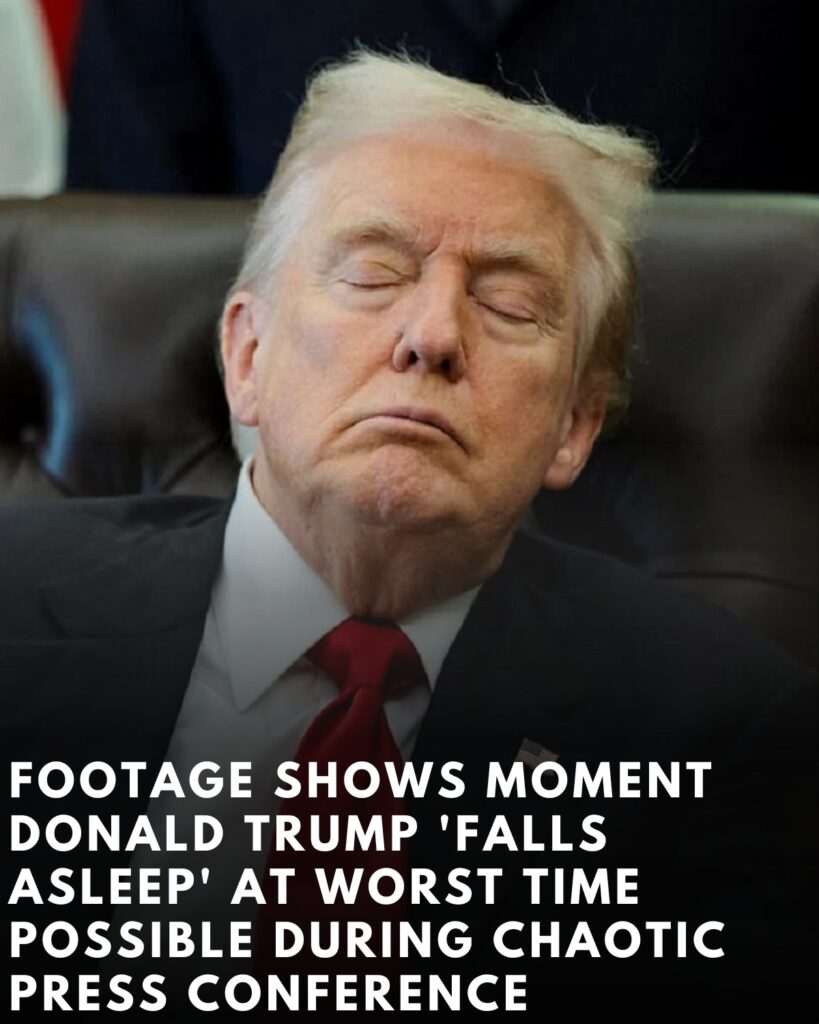
A video from the Oval Office has ignited a fresh row over President Donald Trump’s fitness after he appeared to struggle to stay awake during a White House event announcing price cuts for weight-loss drugs, before the proceedings were abruptly halted when an attendee collapsed behind him. The footage shows Trump seated at the Resolute Desk with senior health officials and pharmaceutical executives standing nearby while Health Secretary Robert F. Kennedy Jr. and others outlined details of the administration’s deal to reduce costs for popular GLP-1 medicines. A Washington Post review of multiple feeds concluded the president spent close to twenty minutes exhibiting classic signs of fighting off sleep—eyes closed for extended moments, head leaning back, a hand pressed to his temple—before the medical emergency prompted staff to clear reporters from the room. The White House later rejected suggestions that Trump had nodded off, insisting he “was not sleeping” and emphasising that he delivered remarks and took questions throughout the announcement.
The event, held to highlight agreements with manufacturers including Eli Lilly and Novo Nordisk, was designed to showcase a signature health policy push: cheaper access to drugs such as Wegovy and Zepbound for eligible Americans. Kennedy framed the move within a broader effort to confront obesity and chronic disease, signalling new federal dietary guidelines would follow in December to reshape the nation’s approach to food and nutrition. In his briefing, he argued obesity is now the leading driver of chronic illness and health-care costs, and suggested forthcoming rules could affect institutions from schools to the military. The policy stagecraft, however, was overshadowed by the optics of the president’s demeanour and the unexpected interruption.
As the presentation unfolded, cameras captured Trump sitting back in his chair with his eyes shut for long stretches while Kennedy and other officials spoke. The Post’s visual analysis stitched together various angles to show a pattern: the president’s posture slouched, his eyelids drooped, and he shifted as if attempting to rally himself, before appearing more alert after the break that followed the attendee’s collapse. The White House press operation responded firmly. In a formal statement reported by the Post, spokeswoman Taylor Rogers said any claim the president had been asleep was inaccurate, calling the Oval Office announcement a “historic reduction in prices” for medicines used by Americans with diabetes, heart disease, obesity and related conditions. The denial did little to stem a flurry of online commentary, where critics seized on the moment as evidence of fatigue in a leader who has long mocked political opponents for similar lapses.
The medical scare that paused the event unfolded on camera. While Eli Lilly’s chief executive Dave Ricks spoke, a man standing behind the president faltered and was helped to the ground as staff and officials, including Dr Mehmet Oz—who now holds a senior health role in the administration—moved quickly to assist. Reporters were asked to leave and live streams were cut. Shortly afterwards, the White House said the man had been treated by the on-site medical unit and was stable, with press secretary Karoline Leavitt telling attendees the conference would resume. When the cameras returned, Trump addressed what had happened, saying the guest had become “a little bit light-headed” and was receiving care. The resumption continued the policy message, but the incident ensured the visuals—first, a seemingly drowsy commander-in-chief, then a sudden collapse behind him—dominated public attention.
Clips of Trump with his eyes closed circulated rapidly across social platforms, often captioned with claims he had fallen asleep. Some posts juxtaposed the footage with past remarks in which Trump derided rivals for perceived lethargy. Others noted the irony of the moment occurring while Oz discussed links between sleep and health during the administration’s obesity initiative. As often happens with viral political video, interpretation split along partisan lines. Supporters dismissed the clips as uncharitable camera angles or a brief rest of the eyes during long remarks by others. Detractors argued that sustained sequences showed more than a blink or nod. The Post’s frame-by-frame accounting—spanning roughly twenty minutes—offered the most detailed public chronology to date, but it did not claim to prove the president was asleep, only that he appeared to be struggling to stay awake.
The broader policy context of the event matters. Kennedy, once a high-profile critic of pharmaceutical companies and certain medical interventions, has been the administration’s face of an effort to expand access to GLP-1 drugs whose demand has surged. He has cast the price-cut package as a pragmatic step to reduce long-term costs associated with obesity and diabetes, previewing dietary guidance changes that, he said, would tackle ultra-processed food and revise norms around fat and sugar consumption. Reuters reported the updated guidelines are due in December and are expected to affect federal programmes and purchasing standards. If enacted, those changes—combined with cheaper GLP-1s—would mark one of the most consequential shifts in U.S. nutrition policy in years.

Yet the day’s narrative was inseparable from optics and health questions that have dogged American politics. Trump has repeatedly portrayed himself as indefatigable, boasting of long workdays and minimal sleep. He has used rivals’ stumbles to draw contrasts, most notably with his “Sleepy Joe” jibe aimed at Joe Biden. When images in past years appeared to show Trump with eyes closed at high-profile moments—during the Republican National Convention or at solemn ceremonies—fact-checks sometimes found benign explanations, such as a prayer segment when many attendees had their eyes shut. Those episodes illustrate how easily still photos or short clips can mislead. But they also explain why the Oval Office video resonated: rather than a freeze-frame or one-off cutaway, the latest sequence played out over minutes, with multiple angles capturing the president during a planned policy rollout at his own desk.
After the interruption, Trump pressed on with the agenda, answering questions and praising the agreement with drugmakers. The Post noted he looked more alert in the second half of the event, even as there were further moments with his eyes closed. White House officials subsequently highlighted the substance of the announcement and the president’s engagement, pointing to a busy travel and call schedule in recent days to bat away suggestions of flagging stamina. Those aides argue the focus should be on the policy benefits for patients facing steep out-of-pocket costs. Critics counter that a president’s public bearing—especially during choreographed moments—matters as a signal of capacity. That debate is likely to intensify as the administration pushes Kennedy’s nutrition overhaul and takes a victory lap on GLP-1 pricing.
The collapse behind Trump injected a second layer of uncertainty into the day. While the identity of the man was not immediately disclosed, on-site statements from the White House emphasised that he was not a Novo Nordisk employee and that he had recovered sufficiently after receiving assistance. News organisations that carried the pool feed reported that Dr Oz was among those who reached him first. The episode echoed a separate moment earlier in the year when a member of Oz’s family fainted at his swearing-in ceremony, an incident that also ended without lasting issues. The repetition of such scenes during high-visibility health policy events added to the surreal feel of a day intended to demonstrate control and competence.
The coming weeks will show whether the White House can pivot back to policy without the lingering image of a weary-looking president overshadowing its message. Kennedy’s promised dietary guidelines are certain to provoke industry pushback and political scrutiny, particularly if they target ultra-processed foods that dominate American diets and school cafeterias. For millions of Americans, the key question will be whether lower GLP-1 prices translate into real access and if insurers follow Medicare and Medicaid in adjusting coverage. For Trump’s political opposition, the Oval Office video will remain a ready shorthand for concerns about age and endurance, regardless of official denials. For supporters, the administration’s case is that the substance of the day—the cost cuts and the signal of a broader anti-obesity drive—outweighs whatever viewers thought they saw on screen.
What is certain is that the Oval Office moment re-centred a recurring theme of modern U.S. politics: health as performance. Presidents are constantly on camera, and long static appearances test even younger leaders’ ability to maintain a composed expression for extended periods. In this case, the policy briefing placed Trump in the background while others delivered extended remarks heavy on statistics and procurement mechanics, precisely the sort of segment that invites the camera to hunt for reaction shots. The Post’s reconstruction indicates the president exhibited behaviours familiar to anyone attempting to stay engaged through a lengthy technical presentation. Whether that reflects simple fatigue—unsurprising in a punishing schedule—or a more troubling pattern is unknowable from video alone. The administration’s categorical denial leaves little room for nuance; the public will judge the pictures for themselves.
The incident also underlined the precariousness of live White House set pieces. The decision to stage the announcement in the Oval Office, an inherently intimate setting, maximised proximity between dignitaries, cameras and the president. When the guest collapsed, there was no buffer to shield the scene. As aides moved to assist, microphones captured fragments—Ricks calling out to check if the man was all right—before staff ushered media from the room. When the conference restarted, the president sought to steady the tone, assuring viewers that the guest was fine and continuing questions on the drug pricing deal. The human element, however, had already taken charge of the narrative.
If the administration hopes to reassert control of that narrative, it will rely on the tangible effects of the price-cut agreements and the forthcoming nutrition guidance. Those measures, if delivered as described, are significant in their own right and politically resonant. But the power of televised images in shaping public perception is no less real. Here, a set of simple facts will endure: at a moment chosen to project command over health policy, the president looked—at least for a spell—like a man battling sleep, and then a guest fainted on camera. The White House says he wasn’t asleep. Americans will decide what they saw.