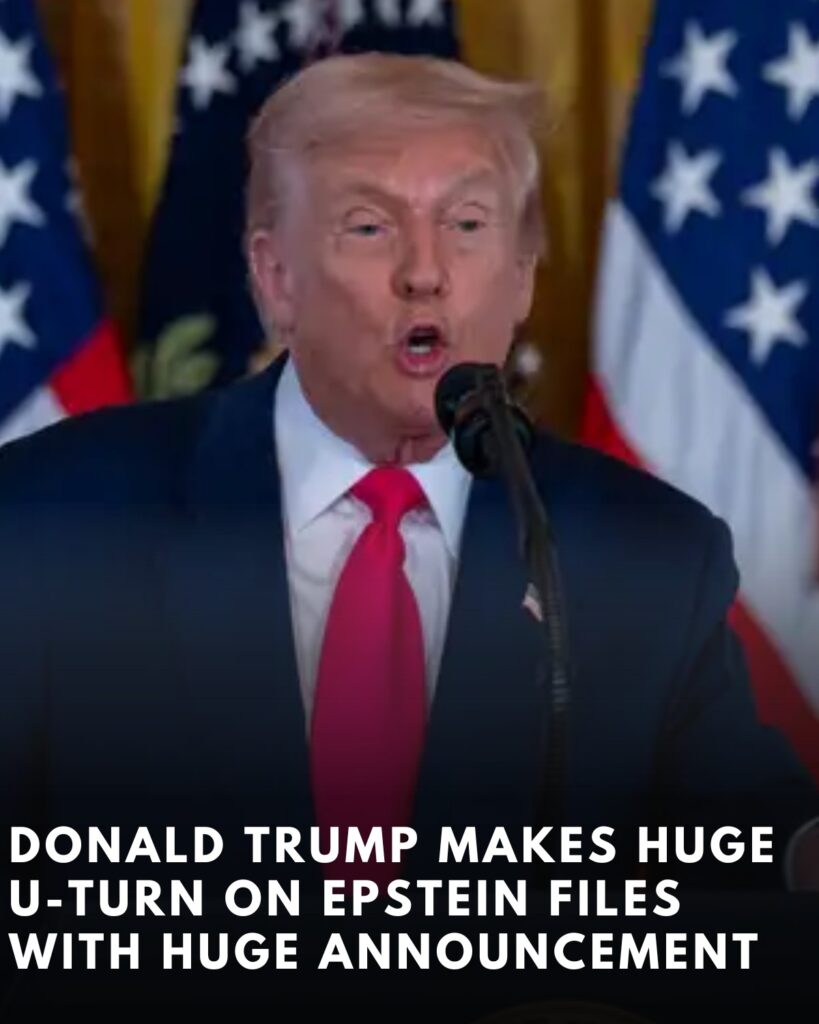
President Donald Trump has reversed his position on the release of government files relating to Jeffrey Epstein, telling House Republicans they should now vote in favour of disclosure and insisting that he and his party have “nothing to hide”.
Writing on his Truth Social platform on Sunday night after returning to Washington from a weekend in Florida, Trump said: “House Republicans should vote to release the Epstein files, because we have nothing to hide, and it’s time to move on from this Democrat Hoax perpetrated by Radical Left Lunatics in order to deflect from the Great Success of the Republican Party.”
The intervention marks a sharp shift from the president’s stance in recent weeks, when he had privately and publicly pressed Republicans to block an effort in the House of Representatives to force the release of the documents. Lawmakers had gathered enough signatures for a discharge petition to bring the measure, known as the Epstein Files Transparency Act, to the floor over the objections of party leaders.
The bill would require the Department of Justice to release all unclassified records, documents, communications and investigative materials related to Epstein, the financier who died in federal custody in 2019 while awaiting trial on sex trafficking charges, with certain redactions permitted to protect victims and ongoing investigations.
Trump’s reversal comes amid growing pressure from within his own party, which has been wrestling with how to respond to revived scrutiny of Epstein’s network of political, business and social connections. Representative Thomas Massie of Kentucky, a Republican co-sponsoring the transparency bill with Democrat Ro Khanna of California, has predicted that “100 or more” Republicans could vote in favour of the measure when it comes before the House this week.
In media interviews on Sunday, Massie argued that releasing the files in full, with appropriate protections, would serve the public interest and avoid any perception that powerful figures are being shielded. He told ABC’s “This Week” that the push was about future accountability and that transparency was necessary “so that this never happens again,” while cautioning that attempts to launch parallel investigations could be used as a “smokescreen” to keep documents classified.
Trump, for his part, has attempted to frame the controversy as a politically motivated effort to damage him ahead of the 2026 midterm elections and any future political plans. In the same Truth Social post, he wrote that the Justice Department had already turned over “tens of thousands of pages to the Public on ‘Epstein’,” said officials were “looking at various Democrat operatives (Bill Clinton, Reid Hoffman, Larry Summers, etc.) and their relationship to Epstein,” and added in capital letters: “I DON’T CARE! All I do care about is that Republicans get BACK ON POINT.”
The president’s allies in House leadership have echoed his claim that the documents will not incriminate him. Speaker Mike Johnson told reporters that Trump “has nothing to hide from this” and argued that Democrats were “doing this to go after President Trump on this theory that he has something to do with it. He does not.”
Trump has never been charged with any crime related to Epstein. His name appears in previously released court and investigative records alongside many other public figures who socialised with the financier before his arrest, but investigators have not accused the president of wrongdoing.
Even so, more than 20,000 pages of material obtained from Epstein’s estate and released by the Republican-led House Oversight Committee this week have drawn renewed attention to the historical relationship between the two men. Among the documents are three emails, from 2011, 2015 and 2019, in which Epstein suggested Trump “knew about the girls”, an allegation Trump has denied.
The files were made public after Democrats first released a small set of emails they said raised questions about Trump’s knowledge of Epstein’s abuse. Republican committee leaders responded by publishing the full cache, arguing that they were preventing selective leaks and demonstrating their own commitment to transparency.
The escalating row over the records has exposed unusual internal strains within the Republican Party. Representative Marjorie Taylor Greene of Georgia, long one of Trump’s most outspoken supporters, signed the discharge petition to force a vote on the transparency bill, alongside fellow Republicans Lauren Boebert of Colorado and Nancy Mace of South Carolina and every Democrat in the House.
Trump reacted furiously, withdrawing his endorsement of Greene and mocking her on Truth Social as “Marjorie Taylor Brown” and writing that “Green grass turns Brown when it begins to ROT!” He accused Republicans who backed the measure of being “very bad, or stupid”, before changing course with Sunday’s statement that they “should vote to release the Epstein files”.
Greene has continued to call for full transparency and has said she does not believe the documents will contain damaging information about Trump. She has argued that any implicated figures, regardless of party, should be held accountable.
Khanna, the California Democrat co-sponsoring the bill, has also framed the effort as a non partisan push for justice, saying in an interview that “there are a lot of other people involved who have to be held accountable” and that the focus should be on survivors of abuse rather than any single political figure.
Trump’s latest comments follow his directive on Friday to Attorney General Pam Bondi to open a new Justice Department inquiry into Epstein’s ties to prominent Democrats and major financial institutions. He specifically cited Clinton, former Treasury Secretary Larry Summers, tech investor Reid Hoffman and banks including JPMorgan Chase, saying he wanted investigators to “determine what was going on with them, and him.”
That move drew criticism from Massie and other supporters of the transparency bill, who questioned whether the launch of a fresh investigation could be used to classify more material and delay publication of the files. Massie suggested that the step risked being seen as an attempt to protect wealthy associates, even if Trump himself had nothing to hide. (The Guardian)
The White House has rejected that characterisation and says Trump is simply keeping a campaign promise to expose the full range of Epstein’s connections. Officials have pointed out that the president previously instructed the Justice Department to release certain records relating to the investigation, and that the latest push builds on that earlier pledge.
Public interest in the case has remained intense since Epstein’s death in August 2019 at a federal detention centre in New York, which authorities ruled a suicide. The financier had already been convicted in Florida in 2008 of procuring a minor for prostitution and served 13 months in a work release programme under a controversial plea deal that has since been heavily criticised. The new congressional legislation would require the Justice Department not only to release files on Epstein’s trafficking network but also to provide more information about the circumstances of his death.
Outside Congress, campaigners and survivors have staged protests and demanded that all remaining government files be released. Demonstrators at a “No Kings” rally in Las Vegas last month carried signs calling for the Epstein files, reflecting broader suspicion about how much is still being withheld and whether politically connected figures have been protected.
Trump himself has sent mixed signals about the level of public interest in the case. At previous events he has at times described the subject as “boring” and suggested that some information in investigative files about Epstein’s associates could be inaccurate, comparing it to what he calls the “witch hunt” of the Mueller inquiry into Russian election interference. Yet the president has also repeatedly claimed that the documents will primarily embarrass Democrats, at one point saying, “Epstein was a Democrat” and suggesting the scandal is “the Democrats’ problem.”
The House is expected to vote on the Epstein Files Transparency Act in the coming days. Supporters say they have the numbers to pass the bill, with dozens of Republicans prepared to join Democrats in favour despite initial resistance from the White House and some in party leadership.
If the legislation clears the House, its fate in the Senate is uncertain. Some senators have signalled openness to further disclosure but have not committed to backing the specific measure. Should it pass both chambers, Trump would still need to sign it into law, a step that would formalise his rhetorical support for releasing the documents and ensure that any remaining unclassified files are made public.
For now, Trump’s decision to tell Republicans to vote for the bill underlines both the political pressure he faces from within his own coalition and his confidence that the files will not directly implicate him. In his Truth Social post, the president urged his party to turn the page, writing that Republicans should “start talking about the Republican Party’s Record Setting Achievements, and not fall into the Epstein ‘TRAP’,” before signing off with his familiar slogan: “MAKE AMERICA GREAT AGAIN!”