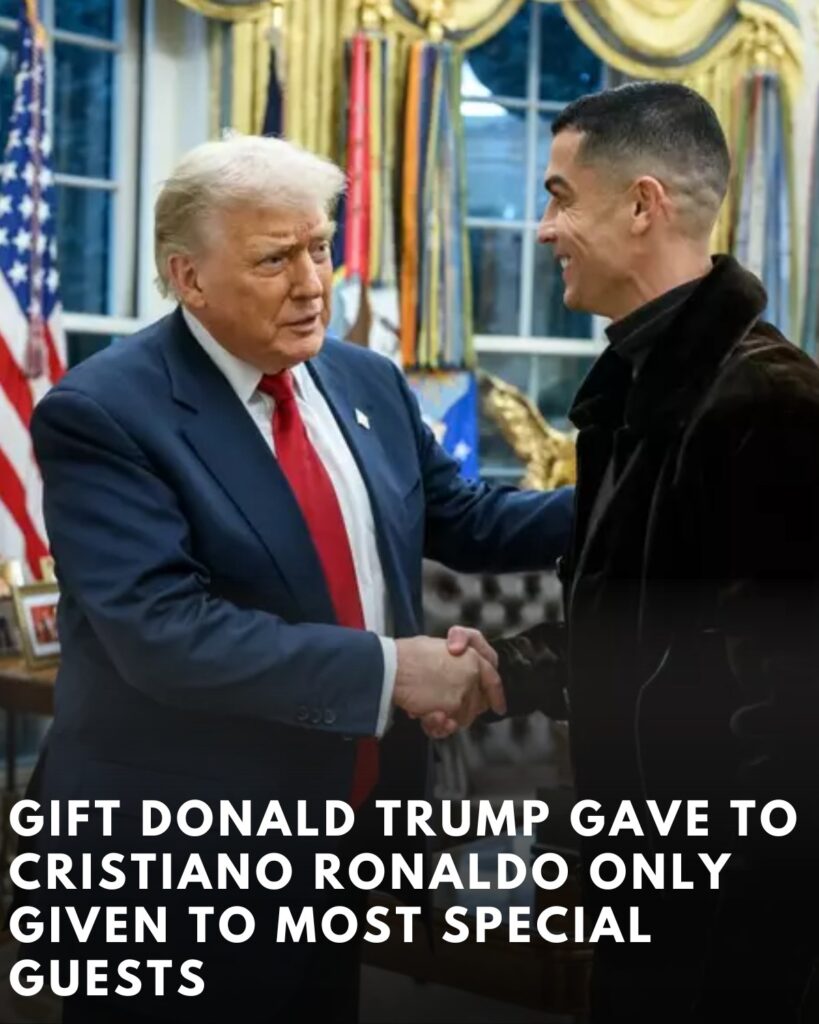
Soccer superstar Cristiano Ronaldo made a high-profile appearance at the White House on Tuesday, attending a state dinner hosted by Donald Trump in honour of Saudi Arabia’s crown prince Mohammed bin Salman amidst intensified diplomatic outreach between Washington and Riyadh.
Ronaldo, the 40-year-old Portuguese forward currently playing for Saudi Pro League side Al Nassr, was seated prominently in the East Room and joined a gathering of global business and political leaders — including the likes of Elon Musk and Tim Cook — as the United States and Saudi Arabia sought to reaffirm ties after years of tension.
During the dinner, Trump singled out Ronaldo in his remarks, revealing that his teenage son Barron had met the footballer and suggesting the meeting had improved the younger Trump’s respect for his father. “Barron got to meet him, and I think he respects his father a little bit more now, just the fact that I introduced you,” Trump said. “So I just want to thank you both for being here. Really an honour.”
Ronaldo later posted on his Instagram account a message of thanks: “Thank you Mr President for your invitation and for the warm welcome you and the First Lady gave me and my future wife, @georginagio,” he wrote. “Each of us has something meaningful to give, and I stand ready to do my part as we inspire new generations to build a future defined by courage, responsibility and lasting peace.”
On the following morning, according to reports, Trump presented Ronaldo with a symbolic “golden key” to the White House during a visit to the Oval Office, a gesture described by Indian media as a mark of respect.
The dinner and Ronaldo’s appearance came at a significant moment. Mohammed bin Salman was making a visit to Washington that marked his most visible U.S. appearance since the diplomatic fallout over the 2018 killing of journalist Jamal Khashoggi, after U.S. intelligence concluded that the crown prince likely approved the operation.
For Ronaldo, the event underlined his evolving role beyond the pitch. After joining Al Nassr in late 2022 on a contract reportedly worth around $200 million per year, he signed a contract extension earlier in 2025 that league and club sources pegged at roughly $400 million. His presence at a White House event with senior U.S. officials and the Saudi leadership reflects how the footballer has become one of the most prominent faces of the kingdom’s efforts to use sports diplomacy as part of its global strategy.
The state dinner also coincided with broader football-world developments: Ronaldo’s native Portugal recently secured qualification for the 2026 FIFA World Cup 2026, which the United States, Canada and Mexico will jointly host. Ronaldo is expected to participate in what he has long signalled will be his final World Cup.
His attendance however comes amidst other personal headlines: the football star received his first-ever red card during an international qualifier earlier this month and remains suspended for at least two matches — potentially including Portugal’s opening match at the tournament.
The event brought together an unusually multifaceted guest list: sports icons, technology billionaires, and state officials. Among the most circulated images from the evening was a selfie taken by Ronaldo that included Musk, FIFA President Gianni Infantino, and Ronaldo’s fiancée Georgina Rodríguez, which quickly gained traction on social media.
Observers note that Ronaldo’s visit and the decision to induct him symbolically into the White House through the key gesture served multiple objectives: for the U.S., it underscored Washington’s outreach to Saudi Arabia via high-profile cultural figures; for Saudi Arabia, it amplified the notion that the kingdom is capitalising on global sport stars to project soft power; and for Ronaldo himself, it stitched together his athletic identity with broader geopolitical visibility.
His Instagram message underlined this framing. While he wrote of inspiring future generations and building a future defined by peace and responsibility, no detailed policy or diplomatic agenda accompanied the appearance. Analysts caution that while sports stars often participate in high-level political and diplomatic forums, their presence does not necessarily signal formal involvement in policy.
From a career standpoint, Ronaldo remains one of the most decorated footballers in history: over 950 goals for club and country as of this year, five Ballon d’Or awards, and a superstar role that transcends sport. The timing of his return to U.S. soil is also significant: his last major appearance in the United States was in 2014, when he played as a substitute for Real Madrid in a friendly against Manchester United in Michigan.
Critics and commentators on social media noted the optics of Ronaldo appearing at the White House alongside Trump and the Saudi crown prince, with some questioning the implications of such a meeting given the earlier global outcry over Saudi human-rights issues. Others pointed to the “TWO GOATS” caption one user attributed to the White House’s post of a video featuring Trump and Ronaldo walking together, which sparked further online discussion.
Yet for the footballer himself, the event appears to have been a wanted milestone. Earlier this year, Ronaldo told interviewer Piers Morgan that he wanted to meet Trump and speak about “world peace” because “he’s one of the guys who can make things happen.” “One of the most important guys is the U.S. President… If we can help each other to make this happen,” he said.
As the global football calendar advances toward the World Cup, Ronaldo’s role in Saudi Arabia and his global consciousness were on full display. Whether his White House appearance translates into any lasting institutional or diplomatic role remains to be seen. What is clear is that the former Real Madrid and Manchester United star has once again positioned himself at the intersection of sport, business and geopolitics — and for at least one evening, inside one of the most symbolic rooms in U.S. government.