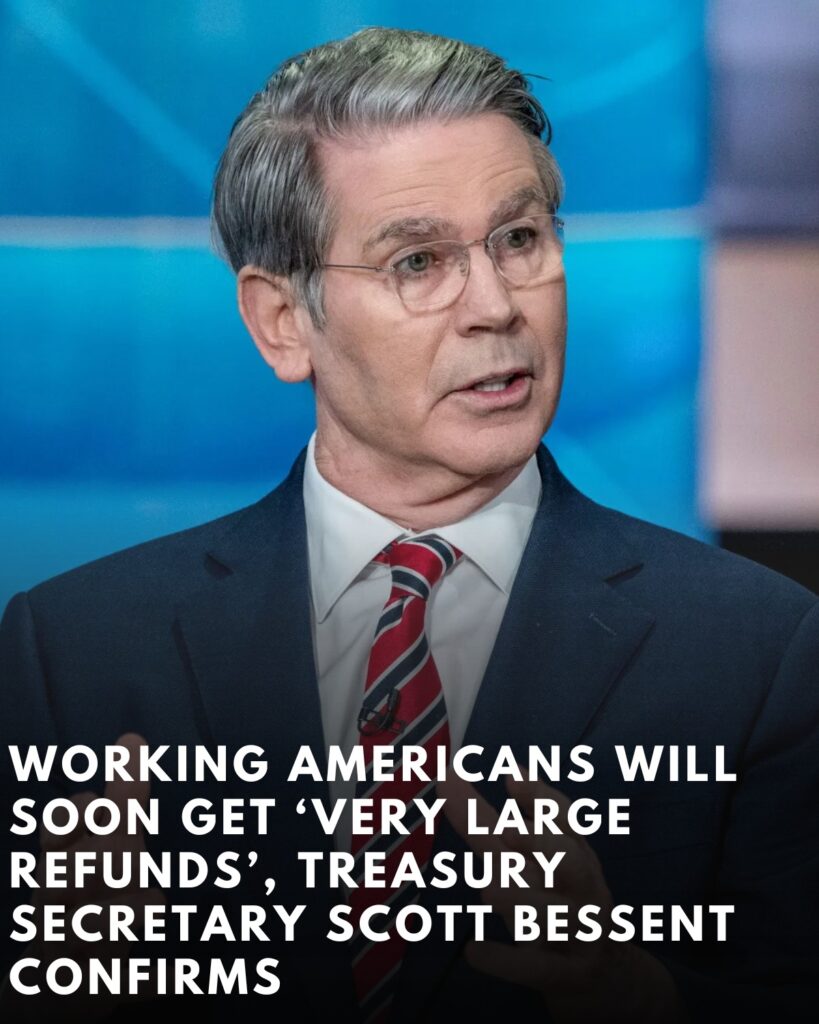
Treasury Secretary Scott Bessent has said working Americans could see “very large refunds” of between $1,000 and $2,000 per household early next year, arguing that the payouts would be driven by a mismatch between workers’ current tax withholding and new tax-cut provisions passed this year.
Speaking this week, Bessent said the refunds would arrive in the first quarter of 2026 and could total as much as $100bn to $150bn. “I think we’re going to see $100-$150 billion of refunds, which could be between $1,000, $2,000 per household,” he said.
The Treasury Secretary’s comments were framed as an early, visible effect of President Donald Trump’s wide-ranging budget and tax legislation, which was approved by Congress in July. Bessent said many employees have not yet adjusted their withholding settings to reflect the new rules, meaning more tax is currently being taken from pay packets than will ultimately be owed for the year, resulting in larger refunds when returns are filed.
Under the US system, many workers pay income tax throughout the year through withholding, the amount automatically deducted from wages and sent to the government. When individuals file their annual return, the Internal Revenue Service reconciles what was withheld against what was owed. If too much was withheld, the taxpayer receives a refund. If too little was withheld, additional tax is due.
Bessent said that dynamic, combined with the timing of the new law, would produce larger-than-usual refunds for many households early next year before payroll withholding is recalibrated. He said that after people receive refunds, they are expected to change their withholding status so that less tax is taken from each pay cheque, shifting the benefit from a once-a-year refund to higher take-home pay.
“Workers will then see a ‘real increase’ in their wages,” Bessent said, referring to the idea that once withholding is adjusted, net pay would rise because less tax is being withheld each pay period.
The legislation contains multiple provisions that the administration has described as aimed at workers’ earnings, including changes linked to the tax treatment of tips and overtime, alongside other measures. Bessent pointed specifically to provisions he said were contributing to the expected increase in refunds, including what he described as auto-deductibility and “no tax on tips”.
While the Treasury Secretary set out a broad range for possible refunds, the figure any household receives would depend on income, withholding choices, eligibility for the new provisions and credits, and personal circumstances such as filing status and dependants. Even within a single income band, refunds can vary widely based on how much tax was withheld throughout the year.

Tax professionals note that the size of a refund is not, by itself, a measure of whether a taxpayer is “better off” overall, because a large refund can also indicate that too much money was withheld during the year that could otherwise have been available in take-home pay. Bessent’s comments suggested the administration expects the initial spike in refunds to be temporary, with the longer-term impact shifting into pay packets as withholding is updated.
The Treasury Department and the IRS typically encourage taxpayers to check withholding after major tax changes. In practice, workers can update their withholding by submitting a revised Form W-4 to their employer, which can change the amount deducted from each pay period. Some taxpayers also adjust withholding to avoid owing tax at filing time, preferring a refund even if it means less take-home pay during the year.
The timing described by Bessent would align with the US tax filing season, which begins in January, when taxpayers submit returns for the prior calendar year. Refunds can be issued in the weeks after returns are processed, though timing varies depending on filing method, verification checks, and whether the return includes certain credits that trigger additional review. Many refunds are paid by direct deposit.
Bessent’s remarks come as the administration promotes the legislation as a major economic plank and as Republicans argue it will boost growth and household finances. The bill was presented as a sweeping package combining spending priorities with tax changes, and Bessent’s comments were positioned as a tangible benefit that people would see in their bank accounts.
Critics of the legislation have argued it disproportionately benefits higher earners and reduces support for lower-income Americans by cutting or tightening access to key programmes. Opponents have pointed to changes affecting Medicaid and food assistance, saying the package risks shifting burdens onto households and state budgets even if some workers see near-term gains through tax changes.
The debate highlights a longstanding political divide over how to measure the impact of large budget and tax packages: the size and distribution of tax relief, the impact on the deficit and public debt, and the effect of spending cuts on public services. The administration’s emphasis on refunds is aimed at a straightforward, household-level metric, though economists often note that a one-time refund is only part of the overall picture, which includes how withholding changes, how wages and prices move, and how any spending cuts are felt.
Refunds can also be affected by how quickly employers and payroll systems implement updated withholding tables, and how promptly workers submit changes to their W-4. If new withholding tables are adopted mid-year, or if workers do not update their withholding to reflect their situation, discrepancies can persist. That means some workers could still see large refunds beyond the initial period, while others might see smaller refunds if withholding is adjusted sooner.
Bessent’s estimate of $100bn to $150bn in refunds suggests the administration expects the effect to be broad-based. However, aggregate refund totals can rise for multiple reasons, including economic conditions, wage growth, changes in withholding behaviour, and policy shifts. Without detailed Treasury or IRS modelling released alongside the remarks, it is difficult to determine how much of the projected refund total would stem directly from the new law versus other factors.
The Treasury Secretary did not lay out in his comments the precise methodology behind the projected aggregate figure or how the administration is defining “per household” in practice, such as whether it refers to tax returns filed jointly, single filers with dependants, or a broader population measure. In tax terms, a “household” can map to a filing unit, but households do not always correspond neatly to tax returns, particularly in cases involving multi-family living arrangements, shared custody, or individuals who do not file.
Even so, the administration’s message is that many working households will receive a noticeable refund bump early in 2026. Supporters of the policy argue that refunds arriving soon after the law’s enactment can reinforce confidence and help households manage expenses, particularly after a period of high prices for essentials.
Tax experts often caution taxpayers not to assume that a large refund means a permanent change to their finances. If withholding is adjusted downward, the annual refund may shrink even if overall tax liability is reduced, because the benefit is received throughout the year in take-home pay rather than as a lump sum.
The politics of refunds can also be complicated. Some taxpayers prefer a large refund as a form of forced saving, while others view it as an interest-free loan to the government. Policymakers have long debated whether the system should encourage precise withholding to reduce refund volatility, or whether refunds serve a useful function for household budgeting.
Bessent’s comments about a “real increase” in wages reflect the idea that take-home pay is what households experience day-to-day, even if gross wages remain unchanged. If withholding declines because tax liability falls, net pay rises, though workers may still choose to have more withheld for other reasons, such as to cover other tax obligations or to avoid a balance due.
With the first quarter of 2026 approaching as the timeframe cited by Bessent, attention is likely to turn to the practical details taxpayers will need to understand: which provisions apply to them, how to adjust withholding, and how to avoid surprises at filing time. Employers and payroll providers typically update systems based on IRS guidance, but individual choices and circumstances remain central to the final outcome.
For households trying to plan, the most immediate implications are that refunds may be larger for some filers next year, and that those who want the benefit spread across pay cheques rather than in a lump sum may need to review their withholding settings. At the same time, opponents of the legislation argue that focusing on refunds risks obscuring the broader trade-offs in the package, including spending cuts and long-term fiscal consequences.
Bessent has framed the coming refunds as a sign the administration’s tax strategy is working and as a preview of a broader shift in household finances once withholding is adjusted. Whether the effect is as widespread as suggested, and how it is distributed across income groups, will become clearer as taxpayers begin filing 2025 returns and as Treasury and the IRS publish further implementation details.