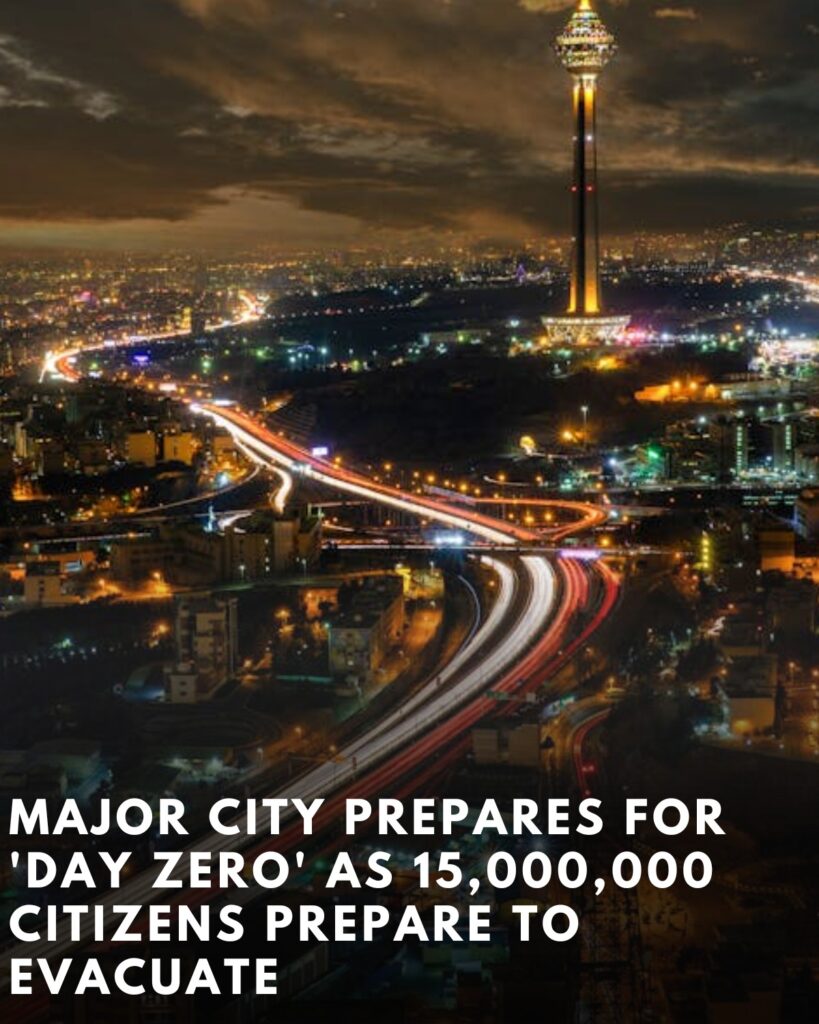
Iran’s capital is facing a deepening water emergency that officials and experts say could push the city towards a so-called “Day Zero”, the point at which taps run dry for large parts of the population, after years of drought and a summer of extreme heat compounded long-standing problems in water governance and infrastructure.
The warning has escalated in recent weeks as reservoir levels have fallen sharply and residents across Tehran have described intermittent or overnight cut-offs, low water pressure and a scramble for storage tanks and pumps. Tehran’s wider metropolitan area is home to around 15 million people, with the urban core housing more than 10 million, and the scale of the risk has led to public discussion of rationing and even the possibility of evacuation if rains do not arrive.
President Masoud Pezeshkian has framed the situation as a national emergency. “Even if we do ration and it still does not rain, then we will have no water at all. They (citizens) have to evacuate Tehran,” he said on November 6, according to Reuters.
Iran’s National Water and Wastewater Company has rejected claims that formal rationing is being imposed in Tehran, but it has acknowledged that water pressure is being reduced at night and can drop to zero in some districts, according to state media cited by Reuters. Those pressure reductions have had immediate effects on households. Reuters reported the experience of a resident in eastern Tehran who said the water stopped without warning. “It was around 10 p.m., and the water didn’t come back until 6 a.m.,” she said, describing how she and her children relied on bottled water to brush their teeth and wash their hands because there was no pump or storage.
The system supplying Tehran is heavily dependent on a small number of reservoirs fed by rivers outside the city. Reuters reported that the capital “depends entirely on five reservoirs”, and cited officials describing steep declines in inflows and stored water compared with last year. The director of Tehran’s water company, Behzad Parsa, has given stark figures for one key source, the Amir Kabir Dam. He said it held about 14 million cubic metres, which is eight percent of capacity, and warned that at current levels it could only continue supplying Tehran for two weeks, according to the IRNA state news agency as reported by Al Jazeera. Reuters similarly cited Parsa saying water levels had fallen 43% from last year, leaving the Amir Kabir Dam at 14 million cubic metres and eight percent of capacity.
Other reporting has highlighted the vulnerability of additional sources. Sky News reported that the Karaj dam, which supplies around a quarter of the city’s drinking water, was eight percent full, while rationing had begun in some areas with tap flow reduced or stopped overnight. The Independent reported that the Latyan Dam, one of Tehran’s five key reservoirs, was about nine percent full, alongside the Karaj dam being eight percent full, and said officials have reduced water pressure, discussed rationing and imposed cuts.
Officials and residents have also pointed to high consumption and strains on infrastructure. Reuters reported that authorities previously said 70% of Tehran residents consumed more than the standard 130 litres a day, and that Pezeshkian warned against over-consumption earlier in the year. At the same time, the crisis has been linked to broader systemic issues. Reuters said decades of mismanagement, including overbuilding dams, illegal well drilling and inefficient agricultural practices, have depleted reserves, citing what “dozens of critics and water experts” have told Iranian state media during extensive national debate on the crisis.
The human impact is already being felt across daily life in Tehran and other cities. A schoolteacher and mother of three, identified only as Shahla, described the cumulative pressures on families. “It’s one hardship after another, one day there’s no water, the next there’s no electricity. We don’t even have enough money to live. This is because of poor management,” she told Reuters by phone from central Tehran.
Beyond the capital, shortages have hit other major population centres. Reuters reported that 19 major dams, roughly ten percent of Iran’s total, have “effectively run dry”, and cited Mashhad, the country’s second-largest city, where reserves fell below three percent. A resident of Mashhad, identified as Reza, described low pressure and the limits of household-level coping measures. “The pressure is so low that literally we do not have water during the day. I have installed water tanks but how long we can continue like this? It is completely because of the mismanagement,” he told Reuters, adding that it was affecting his carpet cleaning business.
Officials have also described the meteorological backdrop in severe terms. Reuters cited Mohammadreza Kavianpour, head of Iran’s Water Research Institute, saying last year’s rainfall was 40% below the 57-year average and forecasts suggested continued dry conditions towards the end of December. Sky News reported that Iran’s National Weather Forecasting Centre described the September to November period as the driest in half a century, with rainfall 89% below the long-term average. The Independent said Tehran’s rainfall in the first two months of the current water year, which begins on 1 October, was near zero, while officials have described “Day Zero” in language that has become a shorthand for a breakdown in supply. “Day Zero, as we call it in the water sector, is near. It’s a day that the taps would run dry,” The Independent quoted.
Climate pressures are central to many explanations of why the system has reached this point. Reuters said authorities have linked rising temperatures to increased evaporation and groundwater loss, and noted that July and August brought record-breaking heat and rolling power outages, with emergency public holidays declared in some areas to reduce water and energy use as temperatures exceeded 50C in parts of the country. In a separate analysis, WIRED said the crisis reflects not only the extreme heat of the past summer but also several consecutive years of reduced precipitation and ongoing drought across Iran, warning that Tehran now faces a potential “Day Zero” when taps could run dry.
The possibility of evacuation has added a rare and unsettling dimension to public discussion. While the Iranian government has not announced a plan to relocate the city’s population, Pezeshkian’s comments have been widely reported and interpreted as a signal of the severity of the threat. Reuters presented the warning in the context of the political risks of a prolonged water emergency, noting that shortages have previously contributed to unrest. In 2021, water shortages in Khuzestan province sparked violent protests, Reuters reported, and there were also protests in 2018, particularly involving farmers accusing the government of mismanagement.
Tehran’s vulnerability is also tied to long-term patterns of extraction and development across Iran’s arid and semi-arid regions. The country’s water stress has been a recurring feature of environmental debate for years, with experts warning that groundwater depletion and land subsidence can become effectively irreversible when aquifers are drained faster than they can recharge. Reporting on Tehran’s immediate shortage has frequently pointed to the tension between short-term emergency measures and structural fixes that require years, investment and political consensus.
For now, authorities have urged residents to conserve and to take household precautions, even as many acknowledge those measures are costly and unevenly accessible. Reuters reported that the public has been urged to install storage tanks, pumps and other devices. Images accompanying Reuters coverage showed people shopping for water storage tanks in Tehran. Temporary measures have also included shifting water between reservoirs and reducing pressure in parts of the network, Reuters reported.
Such stopgap steps have drawn criticism from some residents who say they do not address the underlying problem. “Too little, too late. They only promise but we see no action,” a university teacher in Isfahan said, according to Reuters, adding, “Most of these ideas are not doable.” Reuters also reported criticism in some newspapers of government environmental policies, including allegations about unqualified managers and politicisation of resource management, which the government has rejected.
The crisis has also prompted more unusual responses in public life. Reuters reported that calls for divine intervention had resurfaced, citing Mehdi Chamran, head of Tehran’s City Council, as saying: “In the past, people would go out to the desert to pray for rain. Perhaps we should not neglect that tradition.”
Even as officials debate conservation, engineering solutions and contingency planning, Tehran’s residents are already adjusting their routines around water availability, storing what they can, and preparing for further disruptions as the dry period continues. The scale of the city and its dependence on a limited set of reservoirs mean that even modest drops in inflow can quickly become a widespread problem when demand remains high.
Iran’s government has attributed the crisis to a mix of climate change, over-consumption and policies of previous administrations, Reuters reported. But the convergence of drought, extreme heat, infrastructure strain and political pressure has made Tehran’s situation a symbol of the broader challenge facing the country, where water, energy and economic stress interact in ways that can be difficult to disentangle.
For the moment, much hinges on whether seasonal rains arrive in sufficient volume to slow the depletion of Tehran’s remaining stored water. Without that, the emergency measures already in place could intensify, and the public warnings that once seemed unimaginable for a modern capital, including the possibility of evacuation, could become more than a rhetorical device.