In the quiet, echoing rooms of a house that had grown much too still since the passing of my husband, every sound and every silence seemed amplified. For a year, I had been navigating the uncharted waters of solo parenting, a role that demanded I be both the anchor and the sail for my thirteen-year-old son, Leo. Our relationship was built on a foundation of mutual respect and a shared, unspoken grief, but lately, I felt a distance growing—a subtle shifting of tectonic plates beneath our feet. I was consumed by the frantic rhythm of work and the logistical gymnastics of keeping our lives afloat, often too exhausted to notice the small changes in the weather of Leo’s personality.
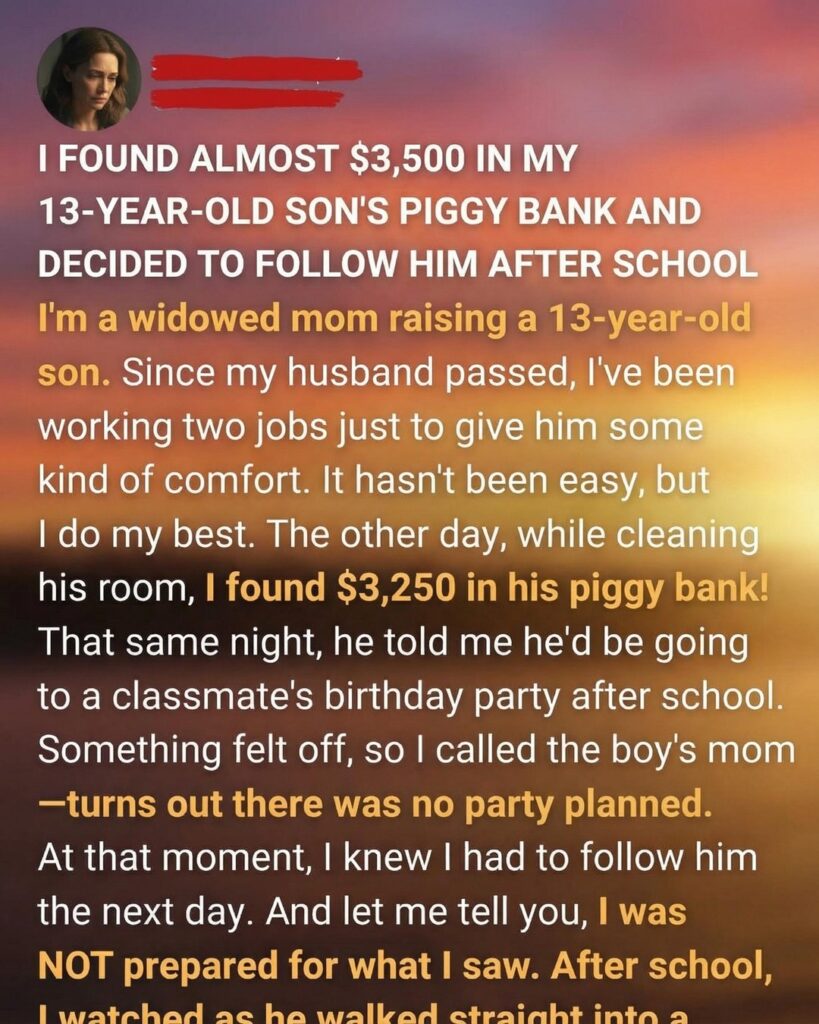
The discovery happened quite by accident. While vacuuming his room, I moved a heavy ceramic piggy bank—a childhood relic shaped like a vintage biplane—to reach a cluster of dust bunnies. The weight of it was startling. It didn’t just rattle with the hollow tinny sound of a few quarters; it possessed a solid, heavy gravity that felt significant. My curiosity, piqued by a mother’s instinct that usually signals trouble, led me to lift the stopper. Inside, nestled among the silver coins, were rolls of twenty-dollar bills and a meticulously folded stack of fifties.
A cold sense of dread settled in the pit of my stomach. We were not a wealthy family, especially not lately. Leo was a boy of modest desires who rarely asked for the latest gadgets or designer clothes, yet here was several thousand dollars hidden in a ceramic plane. My mind, fueled by the “what-ifs” that haunt single parents, immediately drifted toward the dark corners of the internet or the shadowy influences of peer pressure. I realized then that I had been so focused on providing the “how” of our lives—the food, the shelter, the bills—that I had lost track of the “who” my son was becoming in the hours I was away.
That evening, the tension in my chest tightened when Leo mentioned, with a practiced nonchalance, that he was heading to a classmate’s house to work on a group project. It was his tone that betrayed him; it was too polished, a script delivered by someone who had rehearsed it in the mirror. After he left, I did something I had promised myself I would never do: I called the classmate’s mother. Her confusion was immediate. There was no group project, and her son was at soccer practice.
The betrayal stung, but it was eclipsed by a protective fear. I knew that confrontation at this stage would only drive him deeper into his secret. Parenting, I have learned, often requires the patience of an observer rather than the authority of a judge. I decided that the only way to find the truth was to see it for myself.
The following afternoon, I took a half-day from work. I waited in my car a block away from his middle school, feeling like a stranger in my own life. When the bell rang, I watched Leo emerge. He didn’t look like a boy involved in anything illicit. He walked with his head up, his backpack heavy, moving with a sense of destination that seemed at odds with his usual teenage drift. I followed at a discreet distance as he navigated the side streets of our neighborhood, eventually stopping at a small, weathered grocery store on the corner of 5th and Main—a place owned by Mr. Henderson, a man in his eighties who had run the shop since before I was born.
I watched through the window from across the street, my heart hammering against my ribs. What I saw was not a drug deal or a delinquent hangout. I saw my thirteen-year-old son put on a stained apron and begin to methodically restock a shipment of canned goods. I saw him take a broom and sweep the linoleum floors with a thoroughness I had never seen him apply to his own bedroom. For over two hours, he moved with purpose, assisting elderly customers with their bags and helping Mr. Henderson navigate the digital interface of a new lottery machine. He worked with a quiet, humble dignity that left me breathless.
When he finally emerged, he tucked a small envelope into his pocket, shook Mr. Henderson’s hand, and began the walk home. I beat him back by minutes, sitting at the kitchen table with my coat still on, trying to process the revelation.
When Leo walked through the door, the air between us felt different—charged with the truth I now held. I didn’t yell. I didn’t demand an explanation. I simply placed the ceramic biplane on the table and asked, “Leo, can we talk about why you’ve been working at Henderson’s?”
The color drained from his face, and for a moment, he looked like the small child who used to hide behind my legs. He sat down, his shoulders dropping. Then, the words came out in a rush. He told me how he had overheard me crying over a stack of medical bills a few months ago. He talked about the guilt he felt watching me work double shifts, and how he felt the absence of his father not just as a loss of love, but as a loss of security.
“I didn’t want you to feel like you were failing, Mom,” he whispered, his voice cracking. “I just wanted to be like Dad. I wanted to help hold things up. I saved it all because I thought if things ever got really bad, I’d have a way to help.”
Tears blurred my vision as I reached across the table to take his calloused hands. In my effort to protect him from the harsh realities of our new life, I had underestimated his capacity for empathy and his need for agency. He wasn’t just a child being raised; he was a partner in our survival, carrying a weight of responsibility that was far too heavy for his young shoulders, yet carrying it with a grace that was profoundly adult.
I realized that evening that trust isn’t just about believing your child won’t do something wrong; it’s about being open enough to see when they are doing something incredibly right. We decided then that the money would go into a high-yield savings account for his own future, but more importantly, we decided to stop hiding our struggles from one another.
The heavy piggy bank no longer felt like a source of suspicion; it was a monument to his character. Leo taught me that love often speaks in the language of service, and that sometimes, the greatest discovery a parent can make is that their child has grown into the very person they always hoped they would become. We aren’t just a mother and son anymore; we are a team, and the house feels a little less empty now that the silence is filled with the truth.