What happens when you anchor the disciplined, “straight-man” charisma of Henry Winkler against the manic, scene-stealing velocity of a young Michael Keaton? You don’t just get a comedy; you get the definitive blueprint for the 1980s buddy dynamic.
Released in 1982, Night Shift was far more than just Ron Howard’s directorial breakthrough. It was a cult classic in the making, fueled by an electric chemistry that illuminated the grimy corners of a New York City morgue. With Shelley Long providing an irresistible comedic heartbeat and a blink-and-you’ll-miss-him cameo by a pre-superstardom Kevin Costner, the film remains a masterclass in tonal balance. But behind the laughter lies a fascinating story of auditions, Springsteen-fueled prep, and the selfless generosity of a television icon.
From the Slab to the Streets: A Morgue-Bound Enterprise
The premise remains one of the most delightfully absurd setups of the era. Henry Winkler stars as Chuck Lumley, a mild-mannered, over-qualified night shift worker at the city morgue whose quiet life is upended by the arrival of Bill Blazejowski (Keaton). “Blaze” is a self-proclaimed “idea man” with a whirlwind personality and zero impulse control.
The film hits its stride when the duo stumbles into an unconventional business venture: converting the morgue into a dispatch center for a high-end escort service. While the plot could have easily descended into raunchy territory, Howard’s direction and the cast’s inherent likability transformed the “pimps-in-the-morgue” concept into a quirky, empathetic character study.
https://www.instagram.com/p/CRRXDlTlTPS/embed/captioned/?cr=1&v=14&wp=485&rd=https%3A%2F%2Fallmyvista.com&rp=%2F2026%2F01%2F23%2Fnight-shift-surprising-secrets-about-the-80s-cult-comedy%2F#%7B%22ci%22%3A0%2C%22os%22%3A297%2C%22ls%22%3A123.59999999403954%2C%22le%22%3A293.09999999403954%7D
The Arrival of “Blaze”: Keaton’s Breakthrough
It is nearly impossible to discuss Night Shift without centering on Michael Keaton. For modern audiences who know him as Batman or Riggan Thomson, this film serves as a vital time capsule of Keaton in his rawest form—goofy, hyper-kinetic, and undeniably charming.
This was Keaton’s first major starring role, and he was a virtual unknown to the producers at the time. His path to the part was anything but certain. “I don’t know how many times I had to go back in and audition,” Keaton recalled of the grueling process. “It was just callback after callback after callback.”
Keaton eventually won over the room with a unique physical presence: the fast-talking Irish cadence, the darting green eyes, and an energy that felt like a live wire. He later reflected that he arrived at a pivotal moment in industry history—the exact window when the “changeover from television to film actors” was becoming a viable career path.
To maintain Blaze’s high-octane frequency on set, Keaton famously blasted Bruce Springsteen’s “10th Avenue Freeze-Out” to get into the groove. The investment paid off. On opening day, Keaton went to the theater alone to witness the public’s reaction. “I wanted to sit right there in the middle of the theater in the afternoon,” he said. “It was wonderful.”

The Selfless Icon: How Henry Winkler Built a Star
While Keaton’s performance was the one that set Hollywood ablaze, the fire was stoked by Henry Winkler. At the time, Winkler was a household name, still synonymous with “The Fonz.” In an act of professional generosity rarely seen in the industry, Winkler—who was offered his choice of either lead role—opted for the quieter Chuck Lumley.
“Henry helped Michael steal the picture,” director Ron Howard revealed to the Boston Globe. “He gave Michael a lot of choices. With some of the bits, he’d tell Michael, ‘I know [you’ll get laughs] if you take this routine one step further.’”
Winkler viewed the timid morgue director as a necessary palate cleanser after years of playing a leather-jacketed tough guy. As he later joked on social media, “I thought I’d play Richie Cunningham for once.”
The Friction That Fueled the Film
Interestingly, the chemistry between the two leads was born out of genuine initial unease. Upon first reading with Keaton, Winkler expressed reservations to Howard, noting, “The guy’s talented, but I don’t know if I’m comfortable working with him.”
Howard, with a director’s intuition, reassured Winkler that the discomfort was a gift. It mirrored the exact relationship the characters needed: Chuck was supposed to be unsettled by Bill. That early tension provided an authentic, off-balance texture that made their eventual friendship feel earned.
The Road Not Taken: Auditions and Improv
Keaton wasn’t the first choice for Blaze. The production initially pursued heavyweights like John Belushi, Dan Aykroyd, and Bill Murray. Even John Candy was approached, but the “Big Four” of 80s comedy passed, fearing the role was too small or simply not the right fit. Audition tapes were even recorded for Kurt Russell and Mickey Rourke.
Ultimately, writer Lowell Ganz convinced Howard that Keaton was the future. “Keaton is going to be a star for somebody,” Ganz argued, “and he might as well be a star for us.”
Once on set, Keaton was given the freedom to play. One of the film’s most enduring beats—where a blind man asks for change and Keaton’s character blithely writes him a check—was a pure improvisational spark from the actor’s comic genius.
A Family Affair
Night Shift was a modest success, grossing over $21 million, but its legacy as a “Ron Howard film” is cemented by the director’s personal touches. Howard himself makes two cameos: he and his wife Cheryl are seen kissing in front of Chuck’s apartment, and Howard later plays the annoying saxophonist on the subway. True to form, the film also features his brother, Clint Howard, in the role of the quirky Jeffrey.

Decades later, Night Shift remains a testament to a specific era of New York filmmaking—and the moment the world realized Michael Keaton was a force of nature.
Decades after its release, Ron Howard’s Night Shift continues to serve as a fascinating archaeological site for cinephiles. Beyond the career-defining performances of its leads, the film is a treasure trove of “blink-and-you-miss-it” moments featuring future Hollywood royalty.
Look closely during the morgue’s chaotic party scene and you’ll spot a young Kevin Costner. In an uncredited, non-speaking role, the future Oscar winner plays a quintessential frat boy, rocking a checkered shirt and a college cardigan tied around his waist. While Michael Keaton is busy performing gags with a bottle balanced on his head, Costner is simply there, cup in hand, a silent extra in what would become a seminal comedy.
Even more surprising is the feature film debut of Shannen Doherty. Long before she became a household name in Heathers or Beverly Hills, 90210, a young Doherty appeared in an elevator scene as a member of the “Bluebirds” (a youth organization similar to the Girl Scouts), delivering her very first line of cinematic dialogue. These fleeting appearances by future icons lend a retrospective “lightning-in-a-bottle” feel to this quirky classic.
The Surprising Origins of a Humanitarian Anthem
While the film’s soundtrack is anchored by high-energy tracks like Van Halen’s “You Really Got Me” and a live rendition of the Rolling Stones’ “Jumpin’ Jack Flash,” its most significant musical contribution is a song that eventually changed the world.
Night Shift served as the debut for “That’s What Friends Are For.” Originally penned by Burt Bacharach and Carole Bayer Sager, it was first recorded for the 1982 soundtrack by Rod Stewart. While Stewart’s version set the tone for the film’s themes of unlikely companionship, the song achieved immortality in 1986. That year, Dionne Warwick, Elton John, Gladys Knight, and Stevie Wonder collaborated on a cover that not only topped the Billboard charts but raised over $3 million for AIDS research—a legacy that began in a fictionalized New York City morgue.
Shelley Long: From Hesitation to the ‘Wholesome’ Archetype
The casting of Belinda, the sweet-natured but street-smart prostitute who lives next door to Chuck (Henry Winkler), required a delicate touch. Ron Howard had been impressed by Shelley Long in 1981’s Caveman, but bringing her aboard wasn’t easy. Long was in the middle of another production in California when Howard convinced her to fly to Hollywood for a frantic two-day window.
Initially, Long harbored deep reservations about playing a sex worker. However, after extensive research and an audition that Howard described as “cooking” from the moment she read with Winkler, she took the leap. Critics would later marvel at the result, dubbing her “the happiest, most wholesome hooker” in cinema history—a character so endearing that some joked she could lead a Girl Scout troop.
This “wholesome” trend was a hallmark of the era. Night Shift arrived during a strange cultural window where prostitution was a frequent comedic catalyst, sandwiched between the Dolly Parton-led The Best Little Whorehouse in Texas and Tom Cruise’s breakout in Risky Business.
Continuity Gaffes and ‘Magic’ Eggs
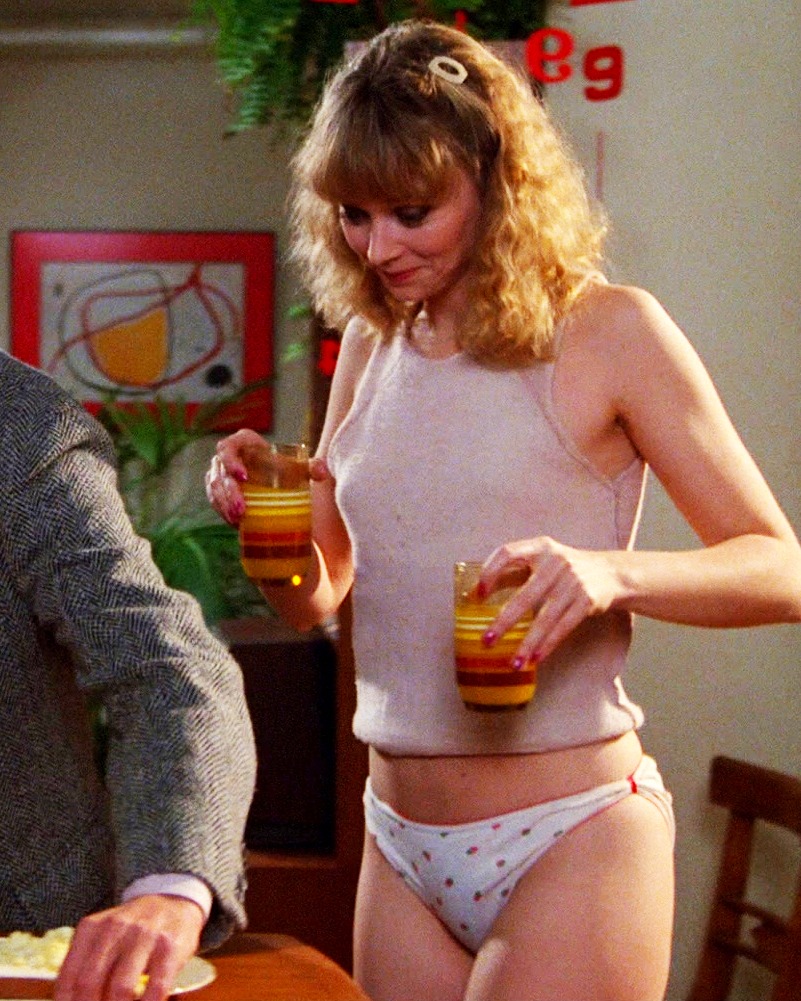
Part of the charm of Night Shift lies in its loose, improvisational energy, which occasionally led to some glaring continuity errors. In one famous scene, Belinda makes breakfast for Chuck while wearing only her underwear—a moment that famously broke Chuck’s “Fonz-like” composure.
Sharp-eyed viewers often point to the “scrambled egg miracle.” When Belinda asks Chuck how he wants his eggs, he requests them scrambled. As the camera cuts back and forth, she is clearly shown frying eggs sunny-side up. Yet, when she finally serves the meal, she magically pours perfectly scrambled eggs onto the plates. Most fans agree that Shelley Long’s charm is so distracting that the breakfast-time sorcery hardly matters.
Other minor slips include a character naming error: while Shannen Doherty is credited as a “Bluebird,” Chuck mistakenly refers to her as a “Bluebell,” confusing his avian organizations with spring flowers.

The Reality of Manhattan vs. The Set
While the film perfectly captures the gritty, neon-soaked atmosphere of Times Square, the morgue itself was a feat of Hollywood engineering, constructed entirely on a set in California. This allowed for the controlled chaos of the party scenes, but the exterior shots remained authentic New York.
One geographical slip-up occurs during a subway scene. As Bill (Keaton) prepares to depart, he announces, “This is my stop,” and exits the train. However, the station signage clearly identifies the train as the Times Square – Grand Central Shuttle—a line famous for having no intermediate stops.
A Final Word on a Perfect Cast
Despite the minor technical errors, the enduring power of Night Shift lies in a trifecta of performances that could never be replicated. The alchemy between Henry Winkler, Shelley Long, and Michael Keaton remains a masterclass in heart and humor. It isn’t just a story about a business venture in a morgue; it is a narrative about finding connection and personal growth in the darkest of places.