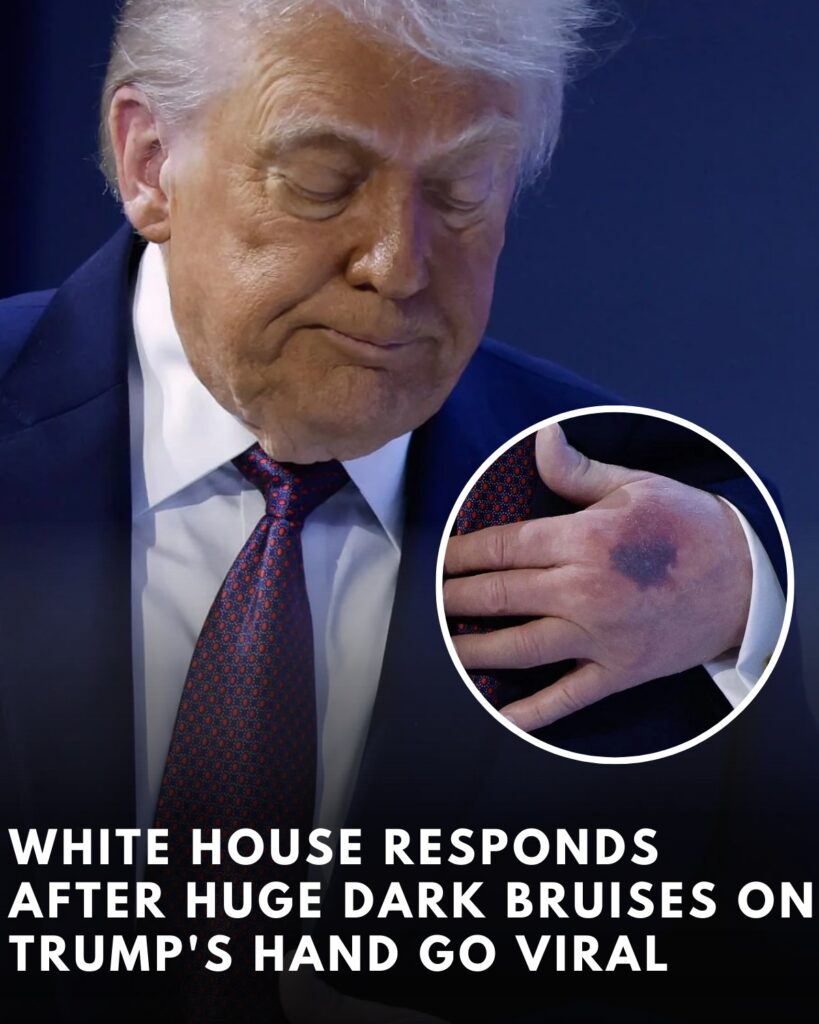
A dark bruise on the back of US President Donald Trump’s left hand drew fresh scrutiny on Thursday after photographers captured images of the mark during his appearances at the World Economic Forum in Davos, Switzerland, prompting a rapid response from the White House and a new round of online speculation about the 79-year-old’s health.
The bruise was visible as Trump hosted a signing event connected to a new US-led initiative he has dubbed the “Board of Peace”, staged on the margins of the Davos gathering. The White House press secretary, Karoline Leavitt, said the injury was the result of Trump striking his hand on the corner of a table during the event.
CBS News producer Sara Cook posted on X that she asked the White House about the bruise and was told by Leavitt: “At the Board of Peace event today in Davos, President Trump hit his hand in the corner of the signing table, causing it to bruise.” The post circulated widely as users shared and zoomed in on photographs of the president’s hand.
The Ladbible report, which described the mark as a “purplish bruise” and said it went viral online, also cited a White House official pointing to Trump’s daily aspirin use as a factor that can make bruising more likely. The article said Trump has previously discussed taking 325 milligrams of aspirin a day.
In recent weeks, Trump has drawn renewed attention for discussing his aspirin regimen in interviews, describing it as a long-standing personal habit. Reuters reported that Trump told The Wall Street Journal he takes 325 milligrams daily rather than the 81 milligrams that is commonly used as a low dose, and linked the practice to his desire to reduce the risk of clotting.
Trump has also spoken in more personal terms about why he prefers the higher dose. In a report referencing the same interview, he was quoted as saying: “They say aspirin is good for thinning out the blood, and I don’t want thick blood pouring through my heart. I want nice, thin blood pouring through my heart.” He described having makeup available to cover marks on his hands and said aspirin can lead to bruising.
The bruise in Davos revived a familiar pattern that has followed Trump through public appearances, where visible marks on his hands have periodically prompted questions about whether he is receiving medical treatment or experiencing age-related health issues. In the past, the White House has attributed similar bruising to frequent handshaking and the physical demands of long days of public events.
On Thursday, the administration again sought to present the latest bruise as an ordinary minor injury, describing it as the result of a bump against furniture during the signing event. The incident occurred as Trump convened invited countries around his proposed Board of Peace, which he has framed as a new international body, launched during the Davos forum.
Al Jazeera, reporting on the same ceremony, described Trump unveiling the Board of Peace in Davos and quoted him as portraying it as a powerful new body that would be able to “do pretty much whatever we want to do”. The outlet said the event took place during the World Economic Forum annual meeting.
The president’s schedule in Switzerland has been closely watched this week as he used Davos to outline parts of his foreign policy and economic agenda, while also drawing criticism for remarks made in speeches and side events. The hand bruise, however, became one of the most widely shared visual moments from his trip, partly because it was captured in close-up photographs as he gestured and shook hands.
Medical experts routinely note that bruising can be more common among older adults, and that aspirin’s anti-platelet effects can increase bleeding and bruising risk by reducing the blood’s ability to clot. Major medical organisations and public health bodies have also updated guidance in recent years to emphasise that daily aspirin is not appropriate for everyone and should be based on individual medical advice.
In its 2022 recommendation statement, the US Preventive Services Task Force advised against initiating low-dose aspirin for the primary prevention of cardiovascular disease in adults aged 60 and older, citing the balance of benefits and bleeding risks. While the guidance focuses on starting aspirin rather than discontinuing it, it underscored the broader shift away from routine daily aspirin in older people without a clear medical indication.
Trump’s own comments have suggested he is aware of the trade-offs. Reports describing his interview remarks said he acknowledged the bruising and that doctors have urged a lower dose, but he has continued with the regimen, describing it as something he has done for decades.
The White House has not indicated that the Davos bruise required medical treatment, and Leavitt’s account framed it as a straightforward knock against the signing table. The administration has previously pushed back against wider speculation about Trump’s health, emphasising that he remains capable of carrying out the duties of the presidency.
Photographs from Thursday showed the bruise spread across the back of Trump’s left hand, with a darker patch near the centre, as he stood at the signing event and later as he appeared in public. Images were circulated by news organisations and widely reposted by social media users, some of whom compared the mark to earlier bruises that had appeared on his hands.
In Davos, Trump has sought to use the global gathering as a stage for his diplomatic messaging, while launching the Board of Peace as an initiative he says can influence international conflicts and negotiations. The White House has promoted the project as part of his broader foreign policy agenda early in his term, even as questions remain about how the body would operate and which countries would formally participate.
The bruise episode also intersected with the ongoing debate over how much information should be made public about a president’s medical care and daily routines. Trump’s decision to discuss his aspirin use in interviews has provided an unusual level of detail about a medication regimen, while also fuelling speculation when physical signs such as bruising become visible during public events.
By late Thursday, the White House explanation was being treated by officials as a complete answer to questions raised by reporters, with no additional medical details offered beyond the description of the table impact and the reference to aspirin increasing susceptibility to bruising. The bruise remained visible in subsequent photographs from the Davos trip, but the administration maintained that it was consistent with a minor injury rather than a sign of a larger health problem.