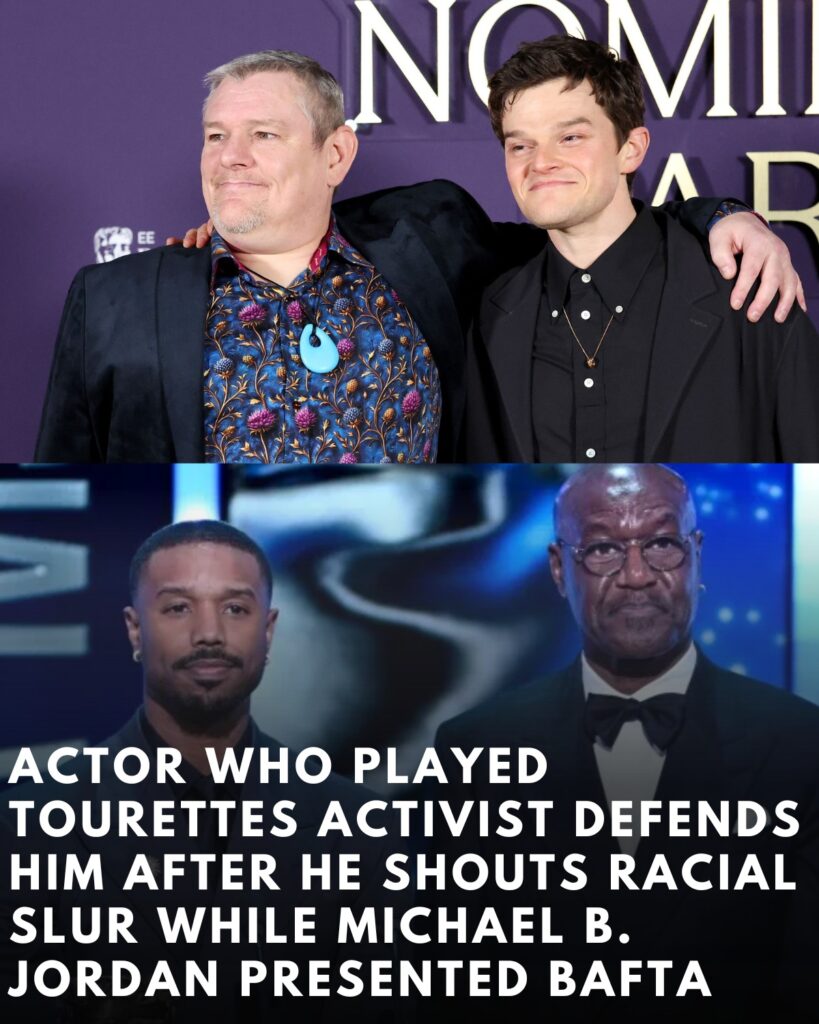
Britain’s film academy and the BBC have apologised after a racial slur was heard during the televised broadcast of the British Academy Film Awards, when a guest with Tourette syndrome shouted the word from the audience as actors Michael B. Jordan and Delroy Lindo were on stage presenting an award.
The incident occurred during Sunday night’s ceremony at London’s Royal Festival Hall, where Jordan and Lindo were presenting the award for best visual effects. The offensive word was audible during the broadcast version of the programme, which went to air around two hours after the live event.
The host, Alan Cumming, addressed the disruption during the ceremony and later apologised directly to the audience for what he described as “strong and offensive language,” explaining that the outburst came from involuntary verbal tics associated with Tourette syndrome. “Tourette syndrome is a disability and the tics you have heard tonight are involuntary, which means the person who has Tourette syndrome has no control over their language,” he said. “We apologise if you were offended.”
Cumming also framed the moment in the context of a nominated film featured at the ceremony, telling the audience that a guest present was Scottish Tourette’s campaigner John Davidson, whose life inspired the film I Swear. According to the Associated Press, Cumming had earlier introduced Davidson to the room, referencing the film and the experience it explores.
The BBC said it regretted the inclusion of the language in the broadcast and acknowledged that some viewers may have heard it. “Some viewers may have heard strong and offensive language during the Bafta Film Awards 2026,” a BBC spokesperson said. “This arose from involuntary verbal tics associated with Tourette syndrome, and was not intentional. We apologise for any offence caused by the language heard.”
The broadcaster later said the slur would be removed from the iPlayer version after it was reported to have remained audible on the service in the hours following transmission, and the AP reported the programme was taken down as the BBC prepared an edited version.
BAFTA referred enquiries to Cumming’s statement when asked for comment, according to the AP report, which noted the academy and broadcaster both apologised in the aftermath.
The moment quickly drew attention online as viewers reacted to the disruption and the fact the slur was heard in the broadcast. LADbible reported that some attendees and viewers claimed additional outbursts were audible at other points in the ceremony, and that Davidson was eventually said to have left the room.
The incident also reignited debate around how broadcasters should handle offensive language that may be produced involuntarily by a person living with Tourette syndrome, particularly when there is time to edit a programme before transmission. Ed Palmer, vice chairman of the charity Tourettes Action, told Times Radio that the BBC should have considered bleeping out the slur. “This is really one of the most acute examples of where something that is a disability can cause quite understandably huge amounts of offense to someone,” he said. “So, if it’s being prerecorded now, then bleeping it out, for example, might be a reasonable compromise.”
Tourette syndrome is a neurological condition characterised by involuntary, repetitive movements and vocalisations, commonly referred to as tics. For some people, symptoms can include the involuntary uttering of socially inappropriate words or phrases, a phenomenon that is widely misunderstood and far less common than other forms of tics, according to standard clinical descriptions referenced in mainstream reporting of the disorder.
John Davidson has been a prominent public campaigner in the UK for Tourette awareness for decades. He first became widely known through the 1989 BBC documentary John’s Not Mad, which followed him as a teenager living with severe Tourette syndrome.
His life and advocacy provided the basis for I Swear, which was nominated at this year’s BAFTAs and won awards on the night, including best actor for Robert Aramayo, who portrayed Davidson.
Aramayo, speaking after his wins, defended Davidson and argued that the public has a role in how Tourette syndrome is understood. Responding to a question about the offensive words heard during the ceremony, he said: “First of all, there are tics. He is ticcing. We have to understand. The way we perceive Tourette’s is a joint responsibility.”
He continued: “It’s not shouting obscenities. It’s not being abusive. It’s Tourette’s. They are tics. If it can lead to a deeper understanding of Tourette’s, and movies are part of that conversation, then it’s an incredible thing.”
LADbible reported that other audible outbursts during the ceremony included shouted profanities, which could be heard in the TV broadcast, reinforcing the unpredictable nature of vocal tics in a high-pressure, crowded setting.
Ahead of the ceremony, Davidson himself had spoken about the risk of heightened tics in an environment like the BAFTAs. ITV News reported that, on the red carpet, he suggested the ceremony could trigger his symptoms. “Certain things – like today, lots of people around, I’m feeling very, you know, more tics in case I lash out. Different situations can trigger different emotions and tics and stuff,” he said in remarks ITV attributed to CNN.
The broadcast controversy also prompted political reaction. ITV News reported that Conservative Party leader Kemi Badenoch criticised the BBC’s decision not to remove the slur before transmission, calling it a “horrible mistake” and arguing that the language should have been bleeped. “Someone with Tourettes said something they shouldn’t have done, we are not going to blame their disability but it should have been bleeped… That is a huge error, that is the first thing that the apology should’ve been made for,” she said on ITV’s Good Morning Britain.
For organisers and broadcasters, the incident has put a renewed spotlight on live event accessibility and inclusion, particularly when people with disabilities are invited into high-profile rooms that are heavily scripted for television but still unpredictable in practice. Cumming, in his on-stage remarks, thanked the audience for maintaining what he described as a respectful atmosphere, while noting Davidson had no control over his tics.
The ceremony itself had been celebrating film performances and productions, but the aftermath has centred on how to balance public understanding of Tourette syndrome with the very real harm caused when the most offensive language is broadcast into people’s homes. The BBC’s apology acknowledged that offence was caused, while reiterating that the language was “not intentional.”