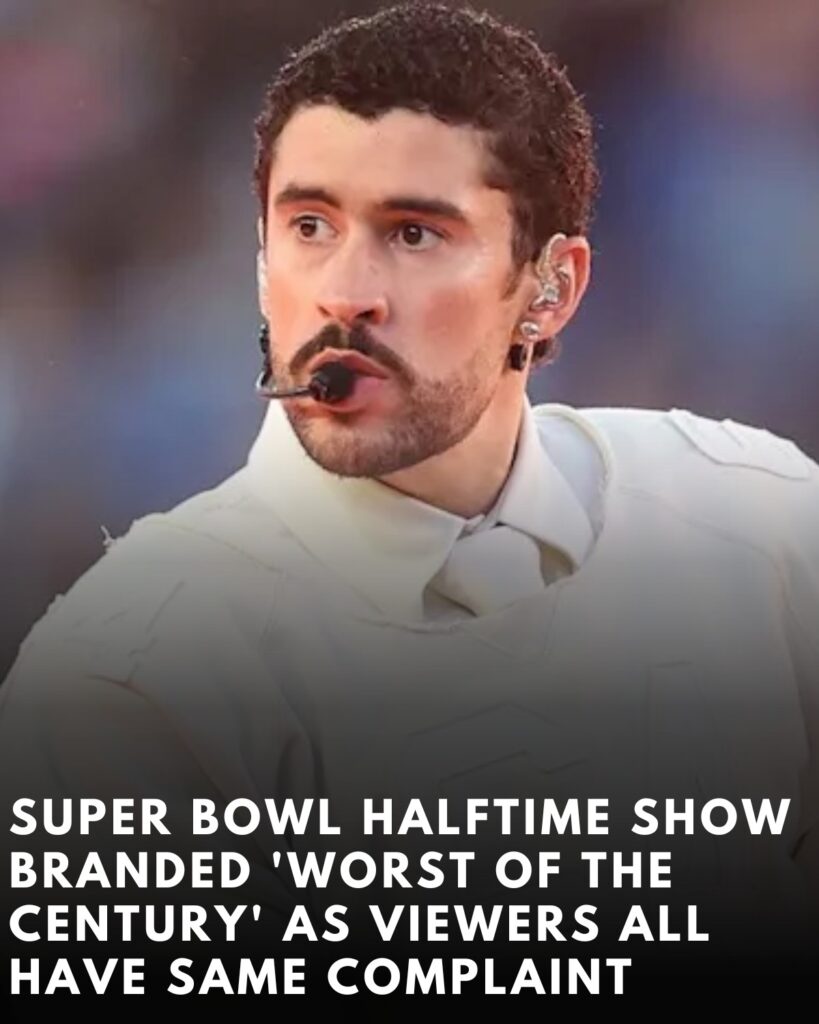
Bad Bunny’s Super Bowl halftime show, performed almost entirely in Spanish, sparked a sharp split in reaction among viewers after the Puerto Rican superstar headlined the Apple Music Halftime Show during Super Bowl LX at Levi’s Stadium in Santa Clara, California. While many praised the set as a cultural milestone and a high-energy production, others took to social media to complain that they could not understand the lyrics and said the NFL had misjudged its audience for the most-watched US sporting broadcast.
The backlash centred on language. UNILAD, which tracked real-time reactions posted online during and after the show, quoted one viewer as writing: “Why as Americans are we watching the Super Bowl half time show in Spanish? With English being our national language, I could not understand a word. Not prejudiced, just don’t understand.” Another social media user, cited in the same report, branded it the “worst Super Bowl this century,” while others posted simple condemnations such as “Worst halftime show EVER!!”
Those complaints circulated as Bad Bunny, 31, delivered a set built around his Spanish-language catalogue, aided by celebrity cameos and guest performances that included Lady Gaga and Ricky Martin, according to multiple postgame accounts of the production and setlist. ABC News reported the show opened with Bad Bunny emerging through a sugar cane field motif and later featured him carrying a Puerto Rican flag, while People and the Associated Press described a performance framed as an ode to Puerto Rican culture, history and diaspora identity.
The NFL amplified the show’s messaging in a social post that declared in Spanish, “Lo único más poderoso que el odio, es el amor,” followed by an English translation: “The Only Thing More Powerful Than Hate is Love.”
By the end of the performance, the language debate had merged with a broader argument about national identity. A number of critics framed their reaction around the idea that English should dominate US public life, an argument that has gained renewed visibility since President Donald Trump signed an executive order in 2025 designating English as the official language of the United States for the first time at the federal level, according to Reuters and the White House’s published text of the order. That order also reversed a Clinton-era framework around language assistance and prompted debate among advocates for multilingual access.
Bad Bunny has been explicit for years that he does not intend to switch languages to broaden his market. In a 2023 Vanity Fair interview referenced by People, he said: “I am never going to [sing in English] just because someone says I need to do it to reach a certain audience.” In the same interview, he described Spanish as the language he uses to live and create, reinforcing the idea that his artistic identity is inseparable from his mother tongue.
That stance is central to his rise from a local Puerto Rican scene to one of the most commercially dominant artists in the world, with a catalogue that has topped global streaming charts while remaining overwhelmingly Spanish-language. The Super Bowl booking, and the creative choices on the night, were interpreted by supporters as a statement that the biggest stage in American pop spectacle could accommodate a Latin artist without translation or compromise.
Positive reactions were also widespread. UNILAD cited a viewer who wrote: “I am an old white guy who doesn’t speak a word of Spanish and I enjoyed the hell out of Bad Bunny’s Super Bowl halftime show,” alongside another post praising the production and the star’s talent despite the language barrier. People similarly reported that the performance leaned into celebration and cultural pride, and described Bad Bunny’s closing moments as a call for unity rather than a pointed political intervention.
In those final moments, Bad Bunny held up a football with the words “Together We Are America,” then spiked it, according to People and other contemporaneous accounts. Yahoo Sports reported he used the prop to underline a message of continental solidarity, while People described him naming countries across the Americas as flags appeared behind him.
The show’s cultural framing landed differently across a fractured audience. Some viewers approached the language issue as a matter of accessibility and taste, arguing that a halftime show should be built around broadly familiar hits. Others treated the Spanish-language set as evidence of demographic and cultural change in the United States, where Spanish is widely spoken and Latino audiences make up a significant share of the NFL’s fanbase and the country’s broader entertainment market. That tension has long surrounded Super Bowl halftime selections, where the audience is vast, heterogeneous, and intensely opinionated, but this year it was intensified by the explicit choice to keep the music in Spanish.
The NFL’s own messaging on the night appeared designed to confront the backlash head-on. Alongside the league’s “hate” versus “love” message, the “Together We Are America” football became a focal point of postgame discussion, spawning explainers and replays across sports media. Even outlets criticising the show’s reception highlighted that, inside the stadium, the production played as a major spectacle, with guest appearances and elaborate staging structured for a television audience.
For Bad Bunny, the controversy sits alongside a career defined by refusing the usual concessions expected of crossover pop stardom. He has consistently delivered Spanish-language albums that dominate global charts, collaborated selectively with English-language artists, and used major US platforms while centring Puerto Rican identity. In the days before the game, he had offered few concrete hints about the set, telling reporters he was focused on enjoying the moment, according to ABC News.
By early Monday, as clips and reactions continued to spread, the divide remained clear. For critics, the main complaint was simple: they did not understand the words and did not want to. For supporters, that complaint missed the point, arguing that halftime shows have always been about performance, energy, and spectacle as much as lyrical comprehension, and that the Super Bowl stage was finally reflecting the multilingual reality of American culture.