At forty years old, I still approach crosswalks with a quiet, instinctive dread. Three years ago, my mother was struck by a distracted driver while legally crossing at a green light. In an instant, everything changed. The accident left her unable to walk again, but the physical injury was only part of the damage. The wheelchair altered how she moved through the world — and how she believed the world saw her. She began to shrink in public spaces, apologizing for positioning, for pauses, for existing in places not designed with her in mind. She often said she hated “taking up space,” as though presence itself required permission. I watched confidence drain from her in grocery aisles and waiting lines, and I learned that disability is not just about mobility — it is about visibility.
When she asked to go to Lark Market with me last week, I hesitated. Lark is our family’s store, though we rarely advertise that connection. She misses ordinary rituals — picking her own apples, comparing flour brands, debating cinnamon quantities like she once did without thinking. We chose a quiet weekday morning to avoid crowds. She wore her gray sweater and the scarf she jokingly calls her “public armor.” For a little while, it felt normal. We gathered flour, apples, pecans, butter. She teased me about our excessive cinnamon supply. For brief, precious minutes, she seemed less guarded, less aware of eyes.
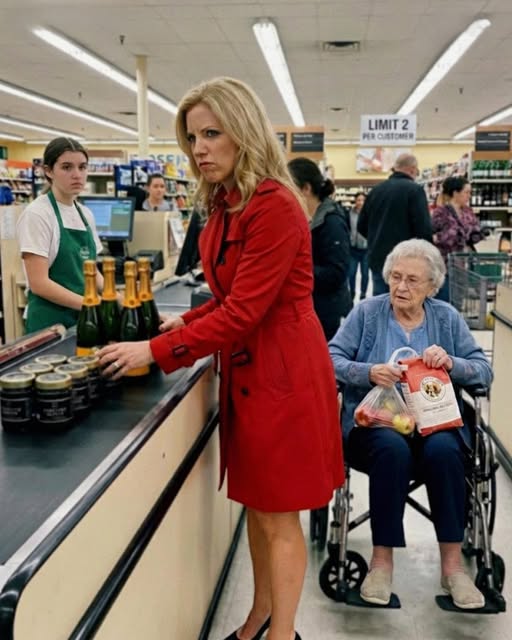
The tension returned at checkout. Even a short line exhausts her now. Being stationary under fluorescent lights, feeling observed, drains her in ways I cannot solve. Then a woman cut in front of us — polished, impatient, pushing a cart loaded with luxury items. Without acknowledging the line, she shoved her cart directly into my mother’s wheelchair. Hard enough to jolt it sideways. When I told her the line began behind us, she smirked and said she didn’t have time to wait behind people who “take up extra space.” The phrase landed like a blow. My mother squeezed my wrist and whispered, “Let it go.” But the woman escalated, snapping at the cashier and threatening to call the owner.
The situation shifted when the intercom announced my mother’s birthday, honoring her as the woman who built the store with her hands and heart. The woman accused us of harassment, then doubled down, referring to the wheelchair as “that thing.” She grabbed expensive items and stormed out without paying. In the office, my brother Ben immediately focused on protecting Mom rather than retaliating. The cashier revealed the woman’s name from a failed loyalty attempt. Ben calmly decided to ban her and report the theft — no spectacle, no revenge.
The following evening, irony placed us face-to-face again. We were catering her gala. When refrigeration failed at the venue, we stepped in to salvage the event. She confronted us, uneasy now. My mother surprised everyone by speaking first. She demanded a direct apology — not a conditional one. Under the quiet pressure of watching guests, the woman complied. The words were reluctant but clear. Later, Ben formally banned her and referenced the footage. The power dynamic had shifted — not through anger, but through steadiness.
The next day, we baked pecan pie. The crust was uneven and slightly overbaked, but my mother closed her eyes and said it was worth taking up space for. In that moment, something fundamental changed. She was no longer shrinking in anticipation of discomfort. She was not apologizing for her presence. The wheelchair had altered her body, but it had not erased her. For the first time since the crosswalk, I saw resilience replacing hesitation. She was still here — and she was done pretending otherwise.